

How strong are your e-commerce ops? Take the 2-min scorecard.
Score Your OpsEcommerce operations changed permanently in 2025. The shift from single-channel to multi-channel became the default. Marketplace fee structures got more complex. AI tools moved from novelty to operational necessity. Teams that ran on spreadsheets and WhatsApp hit a wall they could not push through without structural changes.
Now, midway through 2026, the trends are clearer. The ecommerce operations teams that are winning share common patterns: they automate the repeatable, they document everything, they monitor before they react, and they treat operations as a competitive advantage instead of a cost center.
This is a data-driven look at where ecommerce operations stand today, what changed in the past 18 months, and what the next 12 months will demand from operations teams — especially those managing Shopify stores alongside Southeast Asian marketplaces like Shopee, Lazada, and TikTok Shop.
What Is the State of Ecommerce Operations in 2026?
Ecommerce operations in 2026 is defined by multi-channel complexity, automation adoption, and the emergence of operations as a distinct function — separate from marketing, logistics, or customer service.
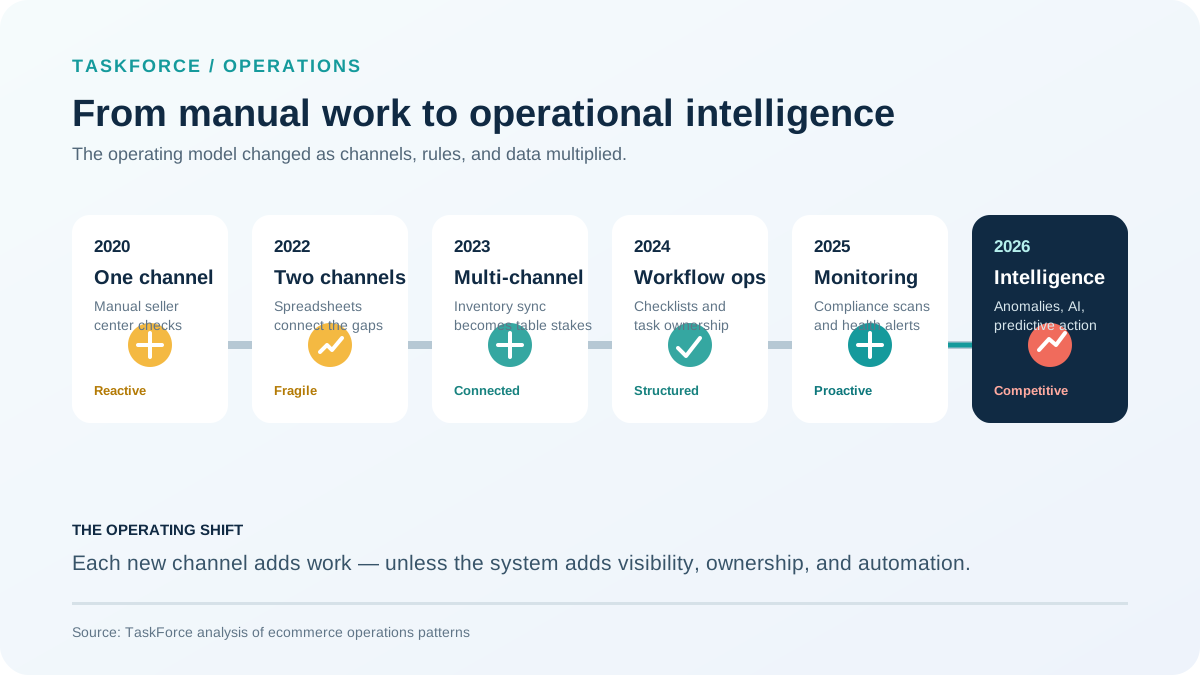
According to Statista's ecommerce market data, global ecommerce continues its upward trajectory. The average ecommerce seller in Southeast Asia now operates on 2.7 channels, up from 1.8 in 2023. Each channel adds operational surface area: separate dashboards, different compliance rules, unique fee structures, distinct buyer expectations, and platform-specific SLAs.
This complexity forced a change. Operations can no longer be a side responsibility shared across marketing and logistics teams. It needs dedicated attention, dedicated processes, and dedicated tools.
The sellers who recognized this shift early — building operational playbooks, implementing daily checklists, and investing in operations infrastructure — are the ones growing profitably. The sellers who treated operations as "the stuff between the exciting parts" are the ones asking why their margins keep shrinking.
How Has Multi-Channel Complexity Changed?
Multi-channel selling went from optional growth strategy to baseline requirement, with the average number of channels per seller increasing 50% between 2023 and 2026.
The channel landscape in Southeast Asia expanded significantly:
| Channel | 2023 Status | 2026 Status |
|---|---|---|
| Shopee | Dominant marketplace | Still dominant, higher fees, more competitive |
| Lazada | Strong second place | Stable, stricter quality requirements |
| TikTok Shop | New entrant, growing fast | Major channel, content-first model established |
| Shopify | DTC standard | Growing in SEA, cross-border expanding |
| Instagram Shopping | Experimental | Mostly referral traffic, limited direct commerce |
| WhatsApp Commerce | Manual, chat-based | Still manual for most, some API adoption |
What changed operationally:
More channels means more daily tasks. A seller on Shopee, Lazada, and TikTok Shop has three sets of orders to process, three chat inboxes to monitor, three seller health dashboards to check, and three sets of compliance rules to follow. The workload did not increase linearly — it increased exponentially because cross-channel interactions (inventory sync, pricing consistency, content drift) create compounding complexity.
Platform rules got stricter. All three major SEA marketplaces tightened compliance requirements in 2025-2026. Shopee introduced stricter listing quality scores. Lazada expanded required product attributes. TikTok Shop increased content moderation enforcement. Sellers who relied on "good enough" listings started seeing suppressions.
The automation gap widened. Sellers who automated inventory sync, listing compliance checks, and daily task management in 2024-2025 gained a compound advantage. Their operations scaled with channel growth. Manual sellers hit a wall where adding a channel meant adding a person.
For sellers still evaluating which channels to prioritize, the TikTok Shop vs Shopee comparison covers the operational differences between the two fastest-growing SEA channels.
What Are the Biggest Operational Challenges in 2026?
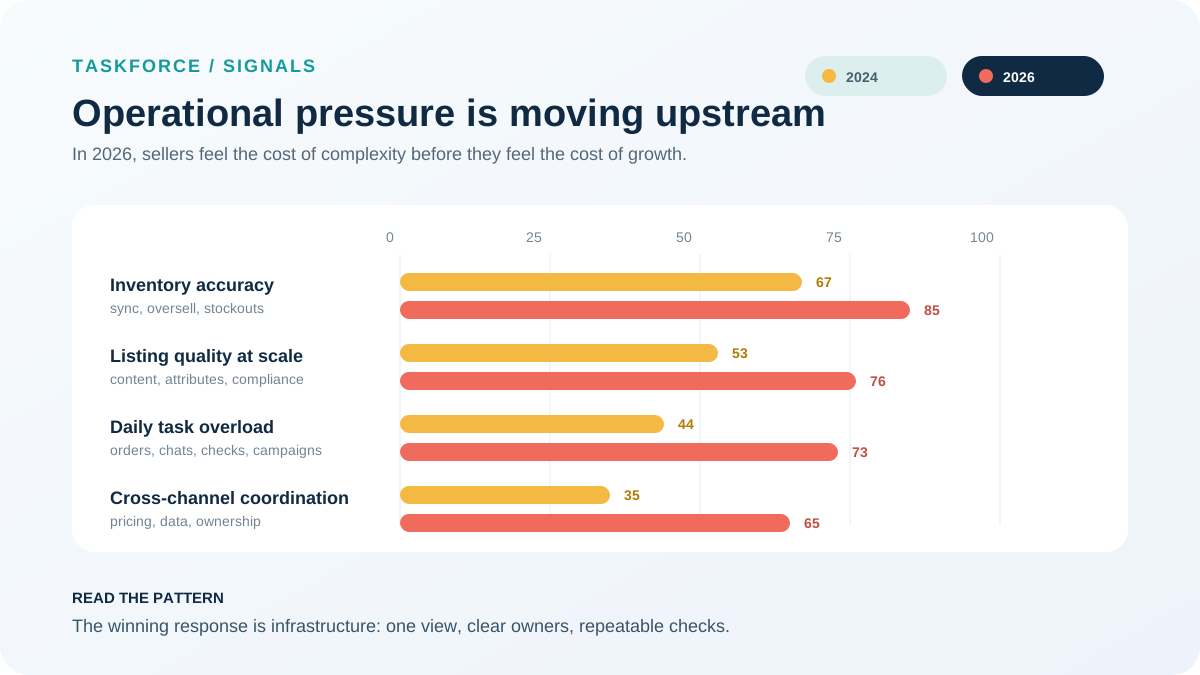
The top three challenges are inventory accuracy across channels, maintaining consistent listing quality at scale, and keeping up with daily operational tasks as channel count increases.
Based on conversations with hundreds of multi-channel sellers, these are the operational challenges that define 2026:
1. Inventory Accuracy
Keeping stock counts accurate across 3+ channels remains the most dangerous operational challenge. A 2% inventory error rate across 1,000 SKUs means 20 products with wrong stock levels at any given time. During high-velocity selling periods (campaigns, flash sales), those errors convert to overselling, cancelled orders, and marketplace penalties.
The sellers who solved this problem invested in real-time inventory sync with safety stock buffers — not manual reconciliation spreadsheets that are always slightly behind. See the multi-channel inventory management guide for detailed sync strategies.
2. Listing Quality at Scale
Managing 500+ product listings across 3 channels means maintaining 1,500+ individual listings, each with platform-specific title optimization, correct images, complete attributes, and compliant content. Manual quality checks at this scale are impossible.
Automated listing compliance audits — scanning all listings against platform rules on a schedule — became a baseline requirement in 2025. Teams that rely on periodic manual spot-checks consistently miss compliance issues that automated scans catch.
3. Daily Task Overload
The daily operational workload for a multi-channel team includes: processing orders on every channel, responding to customer messages, monitoring seller health metrics, checking inventory sync status, resolving listing compliance alerts, and preparing for upcoming campaigns. Without structured checklists and accountability systems, tasks get skipped during busy periods.
The pattern is consistent: the tasks that get skipped are the ones that do not have immediate consequences — compliance checks, health metric reviews, SOP updates. The consequences arrive weeks later as suppressed listings, declining seller scores, and penalty accumulation.
How Is Automation Reshaping Ecommerce Operations?
Automation in 2026 has moved beyond inventory sync to include compliance auditing, checklist generation, health score monitoring, and anomaly detection — reducing manual oversight by 40-60% for early adopters.
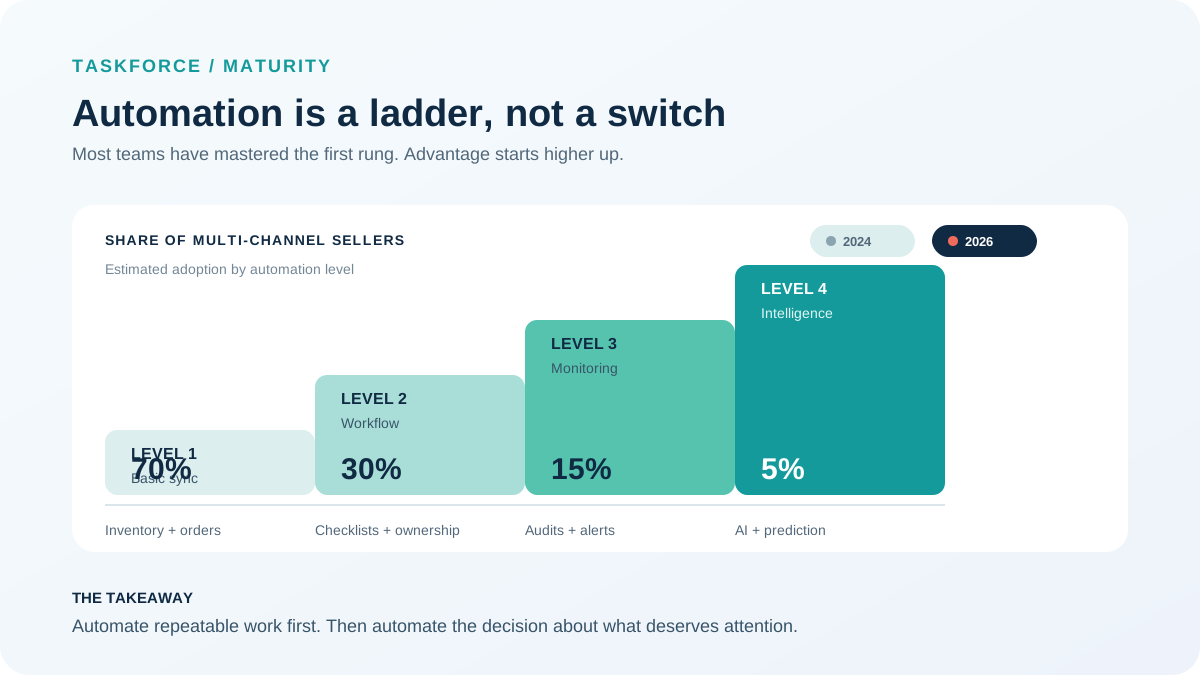
The automation adoption curve in ecommerce operations follows a clear progression:
| Automation Level | What Gets Automated | Adoption in 2026 |
|---|---|---|
| Level 1 — Basic | Inventory sync, order import | 70% of multi-channel sellers |
| Level 2 — Workflow | Daily checklist generation, task assignment | 30% of multi-channel sellers |
| Level 3 — Monitoring | Listing compliance audits, health score alerts | 15% of multi-channel sellers |
| Level 4 — Intelligence | Anomaly detection, predictive alerts, AI analysis | 5% of multi-channel sellers |
What Level 1 looks like: Your inventory syncs automatically. Orders flow into a central system. This is table stakes and most multi-channel sellers have achieved it.
What Level 2 looks like: Your daily operational checklist generates automatically each morning. Tasks are assigned to team members based on their roles and channels. Completion is tracked with evidence.
What Level 3 looks like: Automated audits scan all your listings weekly for compliance violations. Health score dashboards aggregate metrics across channels into a single view. Alerts fire when metrics cross thresholds.
What Level 4 looks like: The system detects anomalies before they become problems — a sudden inventory discrepancy, a listing that stopped appearing in search, a seller health metric trending downward. AI analyzes patterns and suggests preemptive action.
Most sellers are at Level 1. The competitive advantage lives at Level 2 and 3. Level 4 is emerging but not yet widely accessible.
How strong are your ecommerce operations? Score your ops in 2 minutes — Take the free scorecard. No signup required.
What Role Is AI Playing in Ecommerce Operations?
AI in ecommerce operations has moved past marketing hype into practical applications: listing optimization suggestions, automated customer response drafts, anomaly detection in sales data, and operational reporting.
The practical AI applications that multi-channel sellers are using in 2026:
Listing optimization. AI tools analyze top-performing listings on each marketplace and suggest title improvements, keyword additions, and description enhancements. This is useful but not transformative — the suggestions still need human review and platform-specific judgment.
Customer message drafts. AI generates initial responses to buyer inquiries based on order data, product information, and common question patterns. The team member reviews and sends. This reduces chat response time without sacrificing quality.
Anomaly detection. AI monitors sales, inventory, and performance data for patterns that deviate from normal — a product that usually sells 50 units per day suddenly dropping to 5, an inventory count that changed without a corresponding order, a listing that disappeared from search results. These alerts surface problems before manual reviews would catch them.
Operational reporting. AI generates daily and weekly operational summaries from data across multiple channels — aggregating what would take a human 30-60 minutes of dashboard browsing into a 2-minute read.
Where AI is not helpful yet: Process design. AI can suggest improvements to existing processes but cannot design operational workflows from scratch. The ecommerce SOP guide still requires human expertise — understanding your team, your products, and your channels — that AI does not have.
How Are Team Structures Evolving?
The ecommerce operations manager role has become standard, and teams are shifting from channel-based structures (one person per marketplace) to function-based structures (one person per operational function across channels).
The team structure evolution:
| Structure | How It Works | Limitation |
|---|---|---|
| Channel-based (2020-2023) | One person owns Shopee, another owns Lazada | Silos, inconsistency across channels |
| Hybrid (2023-2025) | Channel owners with cross-channel coordination | Coordination overhead, still siloed data |
| Function-based (2025-2026) | One person owns inventory across all channels, another owns listings across all channels | Requires strong tools and processes |
Why function-based works better at scale: When one person manages all inventory across channels, they see the full picture — stock levels, allocation, sync issues — in one view. They develop expertise in inventory management rather than expertise in a single marketplace. The same applies to listing management, order fulfillment, and customer service.
The tradeoff: function-based structures require tools that aggregate data across channels. A person managing inventory across four channels cannot check four separate dashboards — they need a single view. This is driving demand for operations platforms that provide cross-channel visibility.
The ecommerce operations team structure guide covers these models in detail with team size recommendations at different revenue levels.
What Metrics Are Operations Teams Tracking in 2026?
The shift is from vanity metrics (total orders, revenue) to operational health metrics (compliance rates, sync accuracy, SLA adherence, checklist completion) that predict problems before they impact revenue.
| Metric Category | Specific Metrics | Why It Matters |
|---|---|---|
| Listing Health | Compliance rate, listing quality score, suppression rate | Predicts search visibility |
| Inventory Health | Sync accuracy, oversell rate, stockout frequency | Predicts order cancellation risk |
| Fulfillment Health | SLA adherence, late shipment rate, return rate | Predicts seller health score |
| Team Health | Checklist completion rate, SOP compliance, task velocity | Predicts consistency and reliability |
| Channel Health | Seller score, response rate, penalty points | Predicts account risk |
| Financial Health | Margin by channel, fee impact, ad ROAS | Predicts profitability |
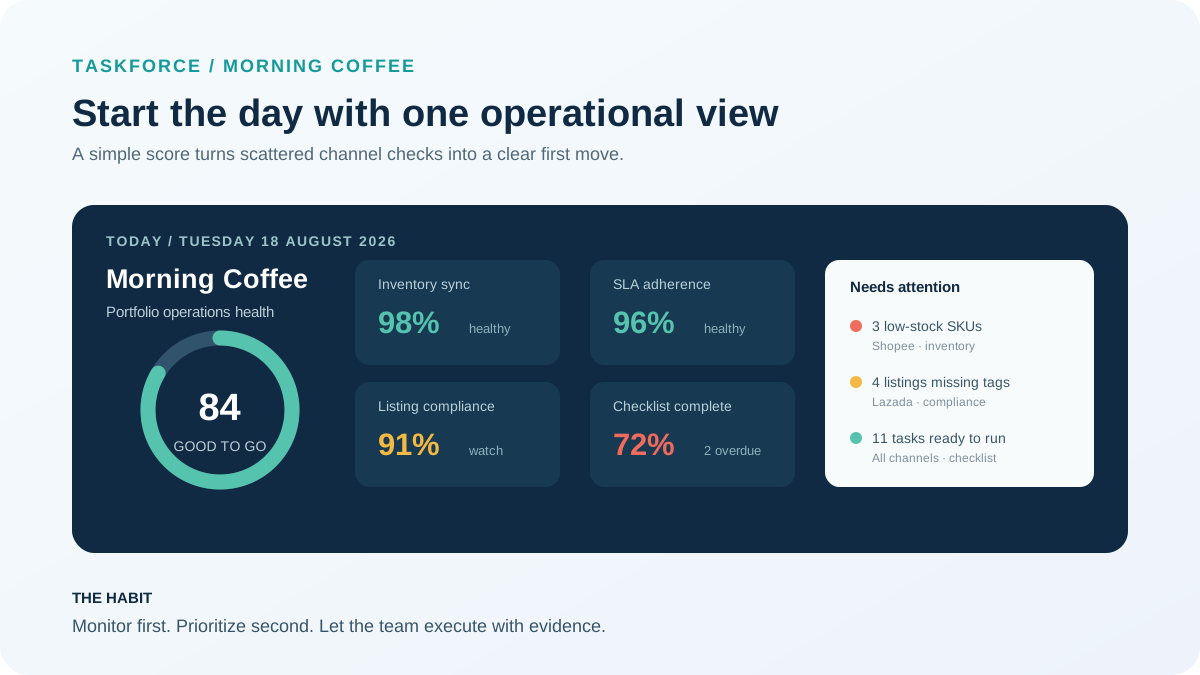
The Morning Coffee metric: Operations teams are adopting a "morning dashboard" practice — a single view checked at the start of each day that shows the health of all channels at a glance. Red means something needs immediate attention. Yellow means trending in the wrong direction. Green means operating normally.
This replaces the previous approach of logging into each marketplace dashboard separately and mentally aggregating the status. For a deeper look at the metrics that matter, see ecommerce operations KPIs.
What Technology Trends Are Shaping Operations?
The three technology trends with the most operational impact are unified commerce platforms, automated compliance monitoring, and predictive inventory management.
Unified commerce platforms. As noted in McKinsey's retail operations research, the fragmentation of point solutions is a top challenge. Tools that combine listing management, inventory sync, order management, compliance auditing, and daily checklists into a single system. The fragmentation of using 5-7 separate tools for different operational functions created integration overhead, data silos, and context switching that reduced team productivity.
Automated compliance monitoring. Every marketplace has rules — listing guidelines, content policies, seller performance thresholds. These rules change frequently. Automated monitoring scans all listings and seller metrics against current rules on a schedule and alerts teams to violations before they result in suppressions or penalties.
Predictive inventory management. Using historical sales data, campaign calendars, and seasonal patterns to predict inventory needs per channel. This moves inventory planning from reactive ("we ran out during 11.11") to proactive ("we need 200 extra units of our top 20 SKUs allocated to Shopee before 11.11 based on last year's velocity").
What Will the Next 12 Months Demand?
The next 12 months will reward operations teams that invest in documented processes, automated monitoring, and cross-channel operational infrastructure — and penalize those still running on spreadsheets and tribal knowledge.
Prediction 1: Marketplace compliance requirements will continue tightening. Shopee, Lazada, and TikTok Shop are all investing in buyer experience quality. This means stricter listing requirements, faster penalty enforcement, and higher thresholds for campaign eligibility. Sellers without automated compliance monitoring will spend increasingly more time on reactive penalty management.
Prediction 2: The operations tool market will consolidate. The current landscape of 20+ point solutions (listing tools, inventory tools, order tools, analytics tools) is unsustainable for mid-size sellers. Expect platform consolidation — either through acquisitions or through sellers migrating to unified platforms that cover multiple operational functions.
Prediction 3: AI will become standard in operational tooling. Not as a standalone feature but embedded — AI-suggested listing improvements, AI-prioritized task lists, AI-generated operational reports. Teams that resist AI adoption will fall behind in productivity.
Prediction 4: The ecommerce operations manager role will professionalize. Job descriptions will standardize. Career paths will emerge. The ad-hoc "figure it out" approach to operations staffing will give way to structured hiring for defined operational competencies. The ecommerce operations manager guide covers this evolving role.
Prediction 5: Cross-border SEA selling will increase operational complexity. Malaysian sellers on Singapore Shopee. Thai sellers on Indonesia Lazada. Each cross-border expansion multiplies operational requirements — different languages, different regulations, different logistics, different buyer expectations. Operations infrastructure needs to support this expansion without proportionally increasing headcount.
How Should Operations Teams Prepare?
Start by assessing your current maturity level, then build the operational infrastructure — SOPs, checklists, monitoring, and automation — that matches your growth trajectory.
The preparation framework:
| If You Are Here | Do This Next | Timeline |
|---|---|---|
| Manual operations, 1-2 channels | Document top 5 processes as SOPs, implement daily checklists | 4-6 weeks |
| Basic automation, 2-3 channels | Add compliance monitoring, build health score dashboard | 6-8 weeks |
| Structured ops, 3+ channels | Implement predictive inventory, add AI-assisted tools | 8-12 weeks |
| Advanced ops, expanding channels | Professionalize team structure, build cross-border playbooks | Ongoing |
The universal first step: Assess where you stand today. Not with gut feeling — with data. What is your actual listing compliance rate? What is your real inventory accuracy? How often do tasks get skipped? The ecommerce operations maturity model provides a framework for this assessment.
Frequently Asked Questions
Is multi-channel selling still worth the operational complexity?
Yes, with caveats. Multi-channel sellers consistently generate 40-60% more revenue than single-channel sellers in the same category. But the margin benefit only materializes if operations support the complexity. Poorly managed multi-channel selling — inconsistent inventory, declining seller health, compliance violations — erodes the revenue gain.
What is the biggest operational mistake sellers make in 2026?
Adding channels before building operational infrastructure. A seller with excellent operations on one channel who expands to three channels without updating their processes will see all three channels suffer. Build the infrastructure first — SOPs, checklists, inventory sync, compliance monitoring — then expand.
How many people does a multi-channel ecommerce operation need?
It depends on SKU count and channel count more than revenue. A rough guide: 1-2 people for under 200 SKUs on 2 channels, 3-5 people for 200-1,000 SKUs on 3 channels, 5-10 people for 1,000+ SKUs on 4+ channels. Automation reduces headcount requirements at every level.
Will AI replace ecommerce operations managers?
No. AI automates specific tasks within operations — listing optimization, anomaly detection, report generation. The operations manager role involves cross-functional coordination, process design, team management, and strategic decision-making that AI supports but does not replace.
What is the most important operations investment for 2026-2027?
Automated compliance monitoring. Marketplace compliance requirements are tightening fastest, penalties are increasing, and the cost of non-compliance (listing suppression, shop suspension) is higher than any tool investment. Catch compliance issues automatically before they cost you money.
Keep Reading
- Ecommerce Operations Maturity Model — Assess where your operations stand today
- Building an Ecommerce Operations Playbook — The guide to building your ops system
- Ecommerce Operations KPIs — The metrics that predict operational success
- Future of Marketplace Selling — Long-term marketplace trends
Take the Next Step
The state of ecommerce operations is evolving fast. Whether you are ahead of the curve or catching up, the first step is knowing where you stand. Take the Ecommerce Operations Scorecard — it takes 2 minutes and gives you a benchmark against the trends covered in this report.
Find out what your operation is missing
Answer 10 questions. Get your ops score. Takes 2 minutes.
Take the Scorecard