

How strong are your e-commerce ops? Take the 2-min scorecard.
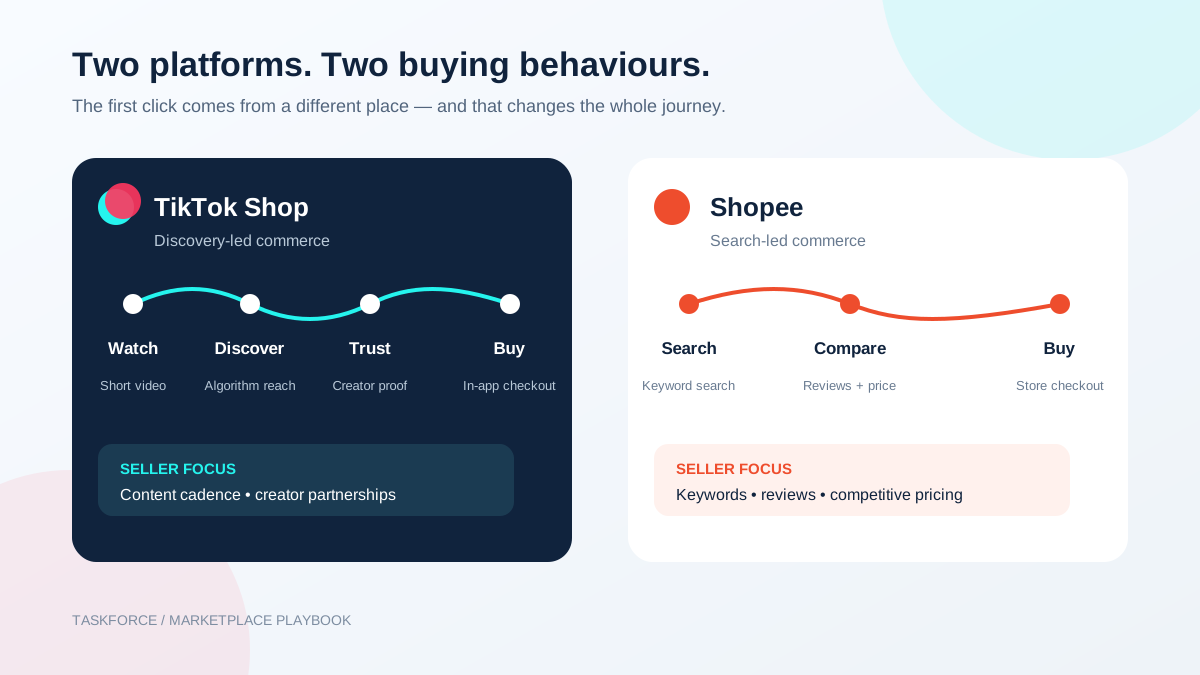
Score Your OpsTwo platforms, two buying behaviors. Shopee buyers search for products they already want. TikTok Shop buyers discover products they did not know they needed. That fundamental difference shapes everything — the content you create, the fees you pay, the products that succeed, and the operations you need to run.
Shopee has been the dominant ecommerce marketplace in Southeast Asia for years, with established logistics, a proven mega-sale calendar, and a massive buyer base. TikTok Shop entered the market as a social commerce disruptor, growing rapidly by converting entertainment attention into purchase intent.
Choosing between them is not about which platform is "better." It is about which platform fits your product, your content capabilities, and your operational capacity. This comparison covers the concrete differences so you can make that decision with data instead of hype.
What Is TikTok Shop?
TikTok Shop is a social commerce platform embedded within the TikTok app that allows sellers to list products and sell directly through short videos, live streams, and an in-app product showcase.
TikTok Shop launched in Southeast Asia in 2022 and has grown aggressively. It turns TikTok's massive daily active user base — over 1 billion globally — into a shopping audience. The TikTok Shop Seller Center is where sellers manage their catalog, orders, and promotions. The buy-now experience is integrated into the content feed: a viewer watches a video, taps the product link, and completes the purchase without leaving the app.
The platform supports three selling formats: product showcase (a mini storefront on your TikTok profile), shoppable videos (products tagged in your short-form content), and live shopping (real-time product demonstrations with checkout).
TikTok Shop's advantage is discovery. Products can reach millions of viewers through the algorithm without paid advertising. A single viral video can generate thousands of orders overnight.
TikTok Shop's challenge is consistency. Algorithm-driven discovery is volatile. A product that sells 500 units today might sell 5 tomorrow if the content stops performing. Building sustainable revenue requires constant content production.
What Is Shopee?
Shopee is the largest ecommerce marketplace in Southeast Asia, operating a search-and-browse platform where buyers find and purchase products through keyword search, category browsing, and campaign-driven promotions.
Shopee operates across Malaysia, Singapore, Indonesia, Thailand, the Philippines, Vietnam, and several other markets. Each country is a separate marketplace with its own seller base, policies, and buyer preferences.
The platform follows the traditional marketplace model: buyers search for products, compare options, read reviews, and purchase. Shopee adds a social layer with chat, live streaming, and feed content, but the core buying behavior remains search-driven.
Shopee's advantage is stability. Buyers come to Shopee with purchase intent. Search traffic is predictable. The mega-sale calendar (9.9, 11.11, 12.12) creates reliable revenue spikes. Seller tools are mature. Logistics are integrated.
Shopee's challenge is competition. Established sellers dominate search results with thousands of reviews and optimized listings. New sellers struggle for visibility without advertising spend or campaign participation. For a deeper look at Shopee selling, see the complete Shopee seller guide.
How Do Fees Compare Between TikTok Shop and Shopee?
TikTok Shop charges 2-8% commission depending on category, while Shopee charges 2-6% commission plus a 2-3% transaction fee — making Shopee slightly more expensive for most categories.
Understanding the full fee structure matters because it directly affects your pricing strategy and margins. Here is the breakdown:
| Fee Component | TikTok Shop | Shopee |
|---|---|---|
| Commission rate | 2-8% (category dependent) | 2-6% (category dependent) |
| Transaction fee | 1% | 2-3% |
| Payment processing | Included in transaction fee | Included in transaction fee |
| Shipping (seller pays) | Via integrated logistics | Via Shopee Logistics or own courier |
| Free Shipping Program | Subsidy available | Subsidy available (wider program) |
| Advertising minimum | No minimum | No minimum |
| Affiliate commission | 1-20% (seller sets rate) | Not applicable (Shopee affiliates separate) |
| Platform voucher cost | Shopee co-funds some | Shopee co-funds more |
The affiliate cost on TikTok Shop is the hidden variable. TikTok Shop's affiliate program lets creators promote your products in exchange for a commission you set. Effective affiliate rates range from 5-15%. This is technically optional, but products without affiliate support get significantly less creator exposure — which is TikTok Shop's primary discovery mechanism.
Total cost comparison example (RM100 product):
| Cost | TikTok Shop (with 10% affiliate) | Shopee |
|---|---|---|
| Commission (5%) | RM5.00 | RM5.00 |
| Transaction fee | RM1.00 | RM2.50 |
| Affiliate commission | RM10.00 | RM0.00 |
| Shopee voucher co-fund | RM0.00 | RM2.00 (estimated) |
| Total platform cost | RM16.00 | RM9.50 |
With affiliates, TikTok Shop costs more per unit. Without affiliates, TikTok Shop is cheaper — but your reach drops dramatically.
How Does Traffic and Buyer Behavior Differ?
Shopee traffic is intent-driven with higher conversion rates per visit, while TikTok Shop traffic is discovery-driven with lower conversion per view but potentially massive reach.
| Traffic Metric | TikTok Shop | Shopee |
|---|---|---|
| Buyer intent at entry | Low (browsing/entertainment) | High (searching to buy) |
| Average conversion rate | 1-3% (from video view to purchase) | 3-8% (from product page to purchase) |
| Traffic source | Algorithm, creators, ads | Search, campaigns, ads |
| Traffic predictability | Volatile (algorithm-dependent) | Stable (search + campaign calendar) |
| Peak traffic events | Viral content moments, live streams | 9.9, 11.11, 12.12 campaigns |
| Repeat buyer rate | Lower (discovery-driven) | Higher (search + favorites) |
| Average session duration | Longer (entertainment context) | Shorter (purchase-focused) |
What this means operationally: On Shopee, you optimize for search visibility — keywords, reviews, pricing. Traffic is predictable and grows incrementally. On TikTok Shop, you optimize for content virality — video quality, creator partnerships, live stream frequency. Traffic is spiky and unpredictable.
Multi-channel sellers who operate on both platforms need different content strategies, different inventory allocation approaches, and different daily routines for each channel. This is where daily operations checklists become essential — the tasks for managing Shopee and TikTok Shop are fundamentally different.
Which Products Sell Better on Each Platform?
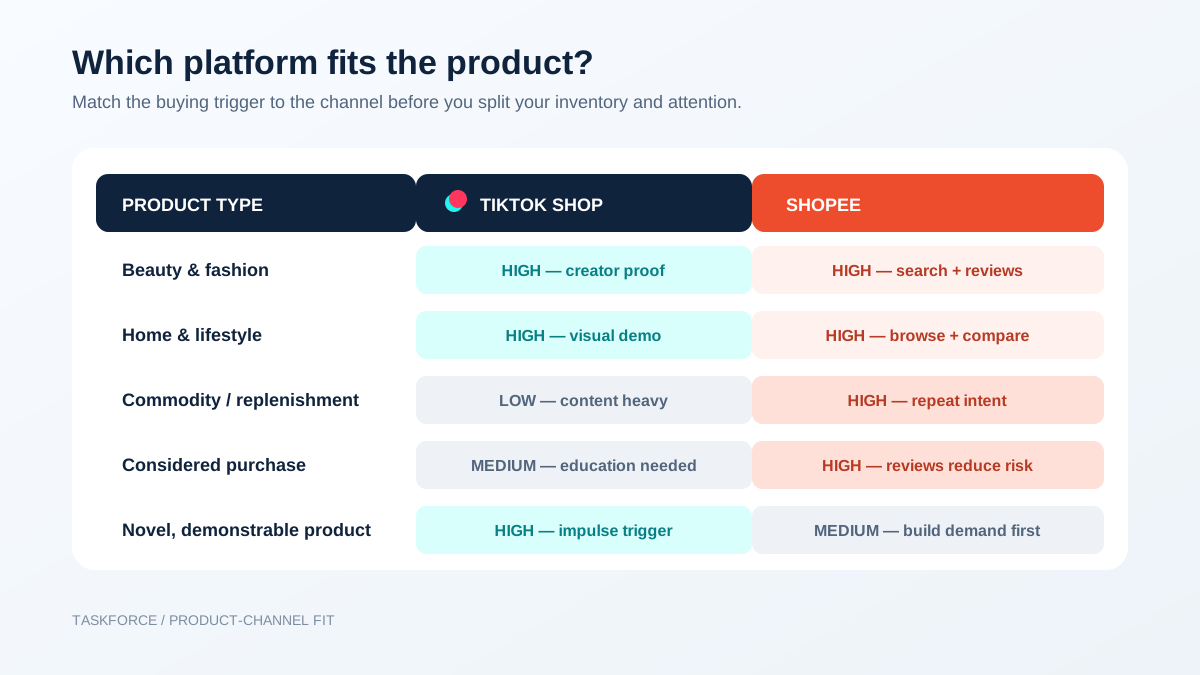
Visual, demonstrable, impulse-friendly products perform best on TikTok Shop. Commodity products, replenishments, and considered purchases perform best on Shopee.
| Product Type | TikTok Shop Fit | Shopee Fit |
|---|---|---|
| Beauty and skincare | Excellent (demo-friendly) | Good (search-driven repurchase) |
| Fashion and accessories | Excellent (visual appeal) | Good (price comparison) |
| Gadgets and novelty items | Excellent (wow factor in video) | Moderate |
| Home and kitchen tools | Good (demo in context) | Good (search and reviews) |
| Electronics and tech | Moderate (high price, considered purchase) | Excellent (comparison shopping) |
| Groceries and consumables | Poor (low visual appeal) | Good (repeat purchase) |
| Industrial/B2B supplies | Poor | Moderate |
| Phone cases and accessories | Good | Excellent (high search volume) |
The pattern: If you can demonstrate the product in a 15-second video and trigger an impulse purchase, TikTok Shop is strong. If the buyer needs to compare specifications, read reviews, and think before buying, Shopee is stronger.
Products that work on both: Beauty, fashion, and home products often perform well on both platforms but through different mechanisms. On TikTok Shop, a skincare product sells because a creator demonstrates the texture and results. On Shopee, the same product sells because a buyer searches for it by name after seeing it on TikTok.
This creates a flywheel: TikTok Shop drives awareness, Shopee captures the intent-driven purchase. Sellers on both platforms benefit from this cross-platform behavior.
How strong are your ecommerce operations? Score your ops in 2 minutes — Take the free scorecard. No signup required.
How Do Seller Tools Compare?
Shopee's Seller Centre is more mature with deeper analytics, while TikTok Shop Seller Center focuses on content performance and affiliate management tools.
| Tool | TikTok Shop | Shopee |
|---|---|---|
| Seller dashboard | Yes (content-focused) | Yes (sales-focused) |
| Product listing manager | Yes | Yes (more fields, attributes) |
| Order management | Yes | Yes |
| Shipping integration | Integrated logistics | Shopee Logistics + own courier |
| Analytics | Video/content performance, basic sales | Sales, traffic, conversion, keyword analytics |
| Advertising platform | TikTok Ads Manager | Shopee Ads (search + discovery) |
| Live stream tools | Native (strong) | Native (improving) |
| Affiliate management | Built-in marketplace | Separate program |
| Chat/messaging | TikTok inbox | Shopee Chat (with metrics) |
| Voucher/promotion tools | Basic | Advanced (vouchers, bundles, flash deals) |
| Seller health metrics | Basic | Detailed (penalty points, ratings, response rate) |
| Campaign nominations | Yes | Yes (more campaign types) |
| API access | Available | Available |
Shopee's advantage: Seller Centre has been refined over years. The analytics are deeper. The promotion tools are more varied. The seller health system is comprehensive — you know exactly where you stand and what to improve.
TikTok Shop's advantage: Creator marketplace and affiliate tools are native. Finding and managing creators who promote your products is built into the platform. Shopee's creator ecosystem is less integrated.
For sellers managing both platforms simultaneously, the operational complexity doubles. Different dashboards, different metrics, different daily tasks. This is where a unified marketplace management approach prevents important tasks from falling through the cracks.
How Does Content Creation Differ?
Shopee requires optimized product listings (images, titles, descriptions). TikTok Shop requires ongoing video content production and live stream scheduling.
The content workload is the most significant operational difference between the platforms:
Shopee content requirements:
- Product images (once, update occasionally)
- Optimized titles with keywords (once, update for campaigns)
- Detailed descriptions (once)
- Campaign banners and voucher creatives (monthly)
- Occasional Shopee Live sessions (optional but beneficial)
TikTok Shop content requirements:
- Short-form product videos (multiple per week, continuously)
- Live stream sessions (regular schedule, 2-4 per week for best results)
- Creator content management (ongoing relationship management)
- Product showcase optimization (ongoing)
- Trend-responsive content (reactive, cannot be batched)
The time investment is not comparable. A Shopee listing takes 30-60 minutes to create and needs occasional updates. TikTok Shop requires hours per week of content creation and live streaming — continuously. Stopping content production on TikTok Shop means your visibility drops rapidly. Shopee listings continue generating search traffic whether you create new content or not.
Team implications: Running TikTok Shop well usually requires a dedicated person for content creation, or a budget for creator partnerships. Shopee can be managed alongside other channels by the same operations team.
How Do Logistics and Fulfillment Compare?
Both platforms offer integrated logistics, but Shopee's logistics network is more mature with wider courier options and more predictable delivery timelines.
| Logistics Feature | TikTok Shop | Shopee |
|---|---|---|
| Integrated shipping | Yes | Yes |
| Courier options | Limited (platform-assigned) | Multiple (seller choice in some markets) |
| Free Shipping Program | Available | More established |
| Shipping labels | Auto-generated | Auto-generated |
| Warehouse pickup | Available in some markets | Widely available |
| Delivery speed expectation | 3-5 days (standard) | 2-4 days (standard) |
| Returns handling | Platform-mediated | Platform-mediated |
| Cross-border shipping | Growing | Established |
For sellers managing fulfillment across both platforms, the daily shipping workflow needs to account for different label formats, pickup schedules, and SLA timelines. A structured order fulfillment process ensures nothing gets missed during peak periods.
Should You Sell on TikTok Shop, Shopee, or Both?
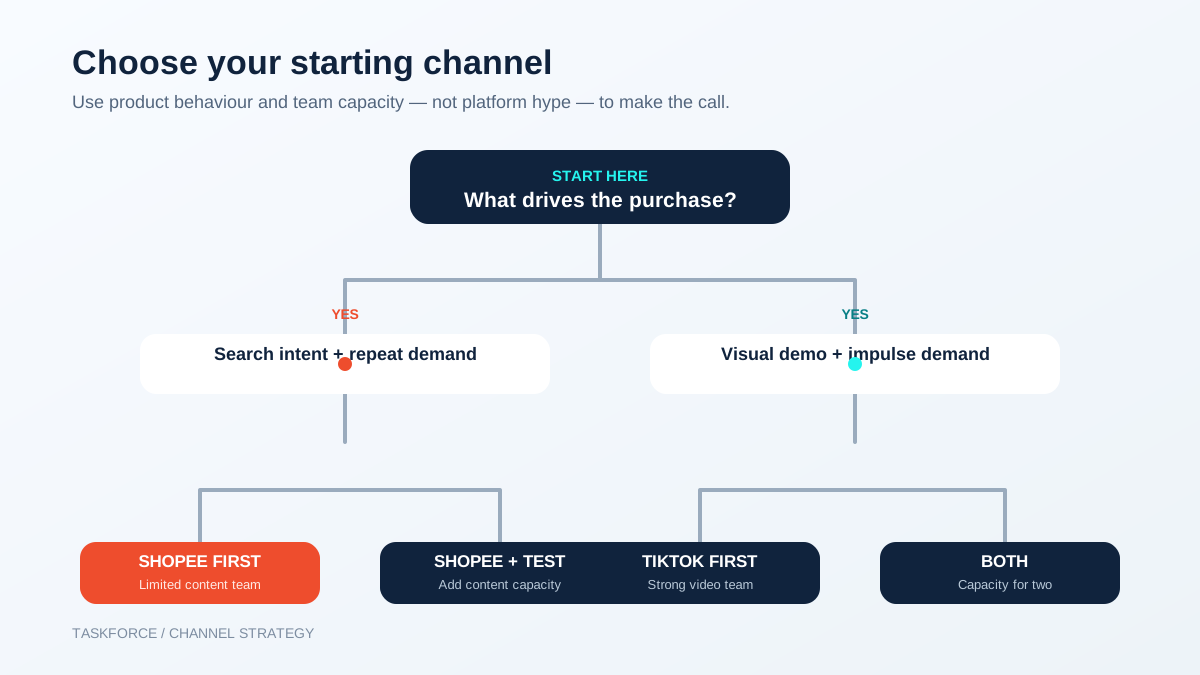
Sell on Shopee first for stable, search-driven revenue. Add TikTok Shop when you have content creation capacity. Sell on both when your operations can handle the complexity.
Here is the decision framework:
| Your Situation | Recommendation | Why |
|---|---|---|
| New to ecommerce, limited team | Start with Shopee | Lower content overhead, more predictable |
| Strong content/video team | Start with TikTok Shop | Leverage content skills for discovery |
| Established Shopee seller | Add TikTok Shop | Cross-platform flywheel, new audience |
| Established TikTok Shop seller | Add Shopee | Capture search intent from TikTok awareness |
| Visual/demonstrable product | Both, TikTok-first | Content drives discovery, Shopee captures intent |
| Commodity/replenishment product | Shopee only | Search-driven purchase, low content ROI on TikTok |
| Limited operational capacity | One platform only | Managing both poorly is worse than managing one well |
The operational reality of selling on both: You need separate listing strategies, separate content workflows, separate inventory allocation, and separate daily checklists. The payoff is significant — cross-platform sellers typically see 40-60% higher total revenue than single-platform sellers — but only if operations can support it.
Running both platforms without a structured operational system leads to missed orders, inconsistent inventory, and declining seller health on whichever platform gets less attention. Most sellers who fail at multi-channel do not fail because of the platforms — they fail because their operations cannot scale with the complexity.
How Do You Manage Operations Across Both Platforms?
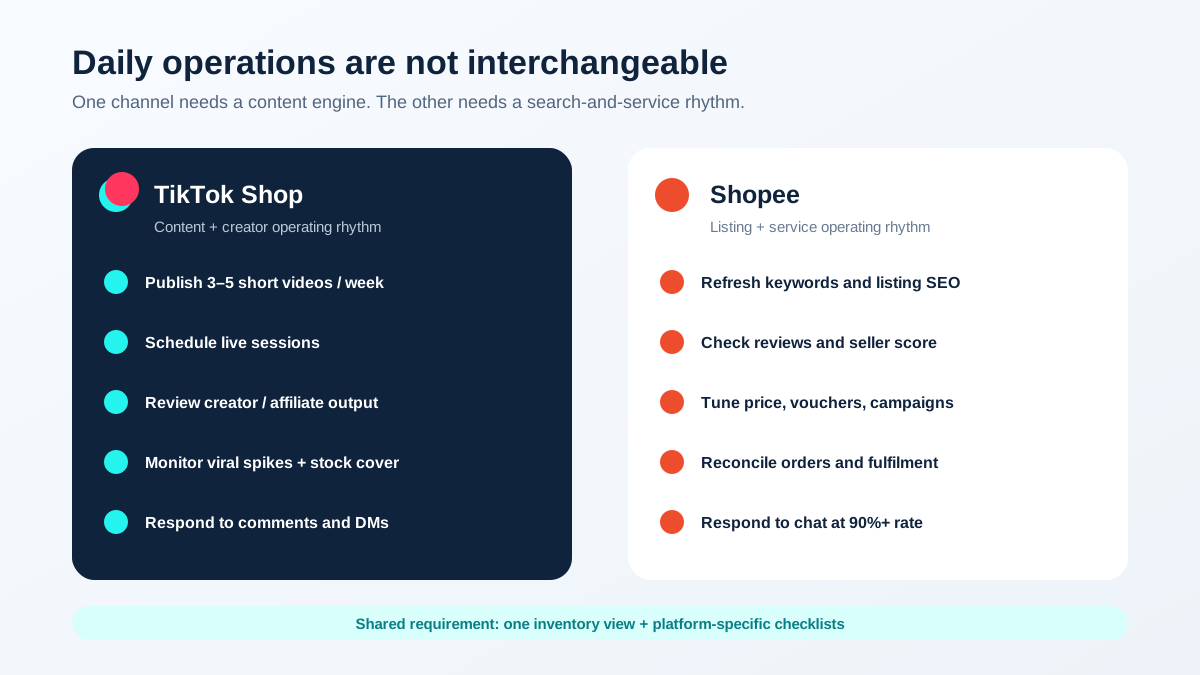
Unified inventory management, platform-specific daily checklists, and a single dashboard for health metrics across both channels are the operational requirements for selling on TikTok Shop and Shopee simultaneously.
The operational tasks that differ by platform:
Daily — Shopee:
- Process orders and print shipping labels
- Respond to Shopee Chat messages (target 90%+ response rate)
- Check and resolve listing compliance alerts
- Monitor seller health metrics
Daily — TikTok Shop:
- Process orders and arrange shipping
- Respond to buyer messages
- Post or schedule product videos
- Monitor affiliate performance
- Review content analytics
Weekly — Both:
- Reconcile inventory across platforms
- Review pricing consistency
- Analyze sales performance per channel
- Plan content and promotions for the coming week
Monthly — Both:
- Run compliance audits on all listings
- Review and adjust pricing strategy
- Prepare for upcoming campaigns
- Assess seller health metrics and address gaps
Without documented processes and checklists for each platform, tasks get skipped during busy periods. The platform that receives less attention sees its seller metrics decline, which triggers a downward spiral of reduced visibility and lower sales.
For a detailed look at managing daily ecommerce tasks across channels, see the ecommerce daily operations checklist.
Frequently Asked Questions
Can I sell the same products on both TikTok Shop and Shopee?
Yes, and most multi-channel sellers do. The listings need platform-specific optimization — different titles, different image emphasis, different descriptions. Pricing can be the same or channel-adjusted based on fee structures. Inventory must be synced to prevent overselling.
Which platform has lower fees?
Without affiliate costs, TikTok Shop is slightly cheaper (3-9% total vs 4-9% for Shopee). With affiliate commissions — which most successful TikTok Shop sellers use — Shopee is cheaper on a per-unit basis. Calculate your actual total cost per order on each platform before deciding.
How much content do I need to create for TikTok Shop?
Plan for at least 3-5 short-form videos per week and 2-3 live stream sessions per week for meaningful traction. Sellers who post less than twice a week typically see their products suppressed in recommendations. This is significantly more content investment than Shopee requires.
Is TikTok Shop growing faster than Shopee?
TikTok Shop's growth rate is higher because it started from a smaller base. In absolute GMV, Shopee remains significantly larger in Southeast Asia. Both platforms are growing — the question is whether TikTok Shop's social commerce model captures enough market share to challenge Shopee's search-driven model in the long term.
What happens if I cannot keep up with both platforms?
Focus on one. A well-run Shopee shop with strong seller metrics outperforms a neglected presence on both platforms. If you add TikTok Shop and find that your Shopee metrics are dropping because of split attention, scale back TikTok Shop until you have the operational capacity to support both.
Keep Reading
- How to Sell on Shopee — The complete Shopee seller guide
- TikTok Shop Seller Guide — Everything you need to start on TikTok Shop
- Shopee vs Lazada — Comparing the two biggest SEA marketplaces
- Selling on Multiple Marketplaces — Multi-channel strategy guide
Take the Next Step
Whether you sell on TikTok Shop, Shopee, or both — your results depend on operational consistency. If you want to see where your multi-channel operations stand, take the Ecommerce Operations Scorecard. It takes 2 minutes and shows you exactly what to fix first.
Find out what your operation is missing
Answer 10 questions. Get your ops score. Takes 2 minutes.
Take the Scorecard