How strong are your e-commerce ops? Take the 2-min scorecard.
Score Your OpsCreators only get paid when you do. That is the deal behind TikTok Shop affiliate commission, and it is also why a careless rate can quietly eat your margin.
This guide is for US sellers who run TikTok Shop alongside other channels. It explains what the commission is, how much you can set, which rate wins when several apply, when creators get paid and how to test a rate against your real costs. Every rule below comes from TikTok Shop's own US Academy pages, which we read on 15 November 2026. Rules change often, so check the page behind each link before you edit a live rate.
One note on scope: these are US marketplace rules. Seller centers in other countries differ, so check your own region's Academy first.
What Is TikTok Shop Affiliate Commission?
TikTok Shop affiliate commission is the percentage of a sale that a seller pays a creator when that creator's video, LIVE or showcase drives the order. Sellers can set 1% to 80% per product, and TikTok Shop US Academy says the commission is calculated as (revenue minus refunds) times the rate.
That is the whole mechanism. You pick a product, you set a rate, and creators choose whether it is worth promoting. TikTok's affiliate overview describes it as paying "only when a sale is made."
There are two sides to the cost. The creator's commission comes out of your sale price. The platform's referral fee comes out too. TikTok Shop's referral fee policy set the fee at 6% per qualified order from 1 April 2024, and category-level rates can differ.
So a "15% commission" is never your only cost. It sits on top of the referral fee, shipping and returns. We come back to the math in a worked example below.
How Much Commission Can You Set on TikTok Shop?
You can set any whole-number rate from 1% to 80% on TikTok Shop US, per product, per group of products or across your whole open collaboration. For guidance, TikTok recommends the median rate of the top 30% of products in your category over the last 30 days.
Source for the range: the Academy guide Setting Up Affiliate Collaborations, updated 10 November 2026. Source for the recommendation: How to use Shop Ad commission rate recommendations.
Here is how that recommendation is built. TikTok looks at every product in your category, such as women's dresses, over 30 days. It scores each on creator click-through and product selection. It then takes the top 30% and uses their median commission as your suggested rate.
That means the "right" rate is not one number. It depends on your category. If you select products from several categories, the Seller Center shows a range instead, for example "15% - 20%".
We have deliberately not given you a "typical" TikTok Shop commission here. TikTok does not publish one, and figures you may see in blog posts are unsourced. Your category benchmark inside Seller Center is the better starting point.
Two more points matter before you pick a number:
- You stay in control. TikTok says you can ignore the recommendation and set your own rate at any time.
- Rates need a review habit. TikTok's own tip is to check rates quarterly, because "what's competitive today might not be in a few months."
Open, Target or Flat Fee: Which Collaboration Fits?
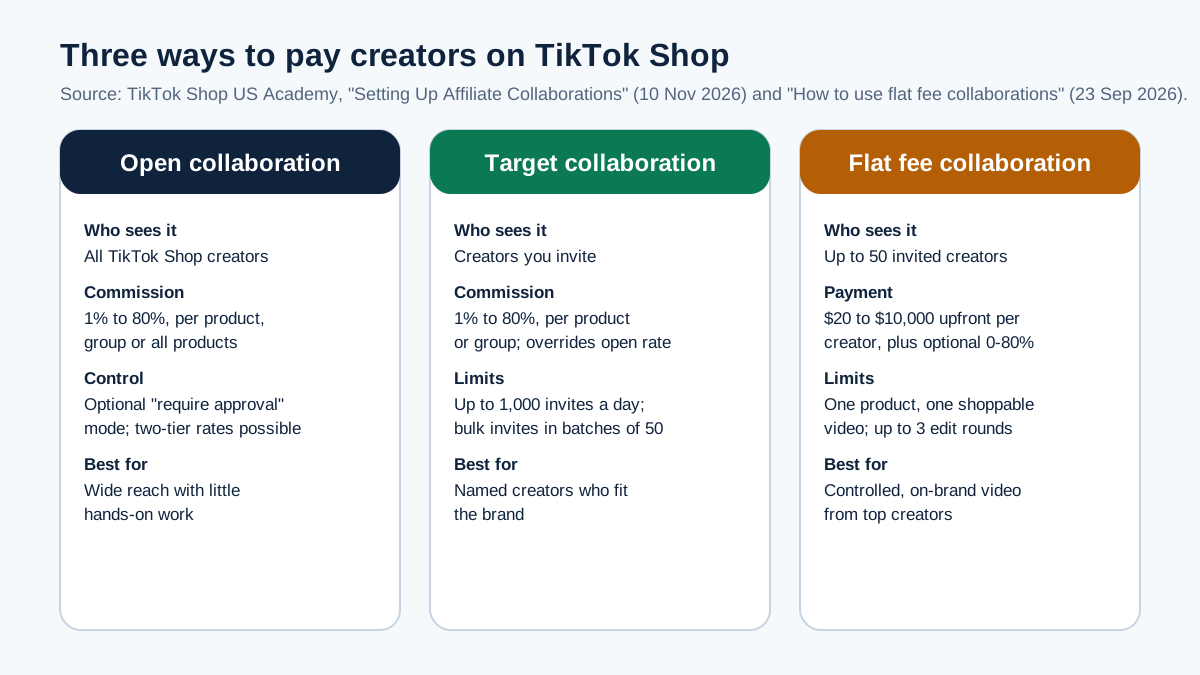
TikTok Shop offers three ways to pay creators: open collaboration (visible to all creators), target collaboration (invited creators only, up to 1,000 invitations per 24 hours) and flat fee collaboration (an upfront fee of $20 to $10,000 per creator, with optional commission).
The figures come from the Academy guides on affiliate collaborations and flat fee collaborations.
| Open collaboration | Target collaboration | Flat fee collaboration | |
|---|---|---|---|
| Who sees it | All TikTok Shop creators | Creators you invite | Up to 50 creators per invite |
| Commission | 1% to 80% | 1% to 80% | Optional 0% to 80% on top of the fee |
| Upfront payment | None | None | $20 to $10,000 per creator |
| Products | Selected products or all | Selected products | One product per collaboration |
| Content | Any eligible video or LIVE | Any eligible video or LIVE (optional LIVE-only for samples) | One shoppable video, up to 3 edit rounds |
| Best for | Wide reach, little hands-on work | Named creators who fit the brand | Controlled, on-brand video |
Source: TikTok Shop US Academy, pages updated 10 November 2026 (affiliate collaborations) and 23 September 2026 (flat fee).
Open collaboration: reach first
Open collaboration makes your products visible to every TikTok Shop creator. You can switch on "require approval" mode so only creators you approve can promote. TikTok also adds products automatically unless you turn off the auto-add toggle, so check that setting on day one.
The risk is simple. If you list a new SKU before you have costed it, auto-add can offer it to creators at the recommended or flat rate you chose in its settings. Decide whether you want that before your next product upload.
Target collaboration: fit first
A target collaboration invites specific creators to promote specific products. You can send invitations in batches of 50 creators and up to 1,000 target collaborations in 24 hours. TikTok recommends setting target rates higher than your open rate, and the reason is in the next section: the target rate always wins.
Free samples work inside target collaborations too. TikTok notes that products offering relevant free samples rank higher when recommended to creators.
Flat fee: control first
Flat fee collaborations pay a creator upfront and let you add a commission. The payment is locked by the platform until the creator's video passes review. You can request up to three rounds of edits. You have 14 days per review round, and if you miss it the content is approved automatically and the fee is paid.
Use this when you need a specific kind of video, not just any sale.
Which Commission Rate Wins When Several Apply?
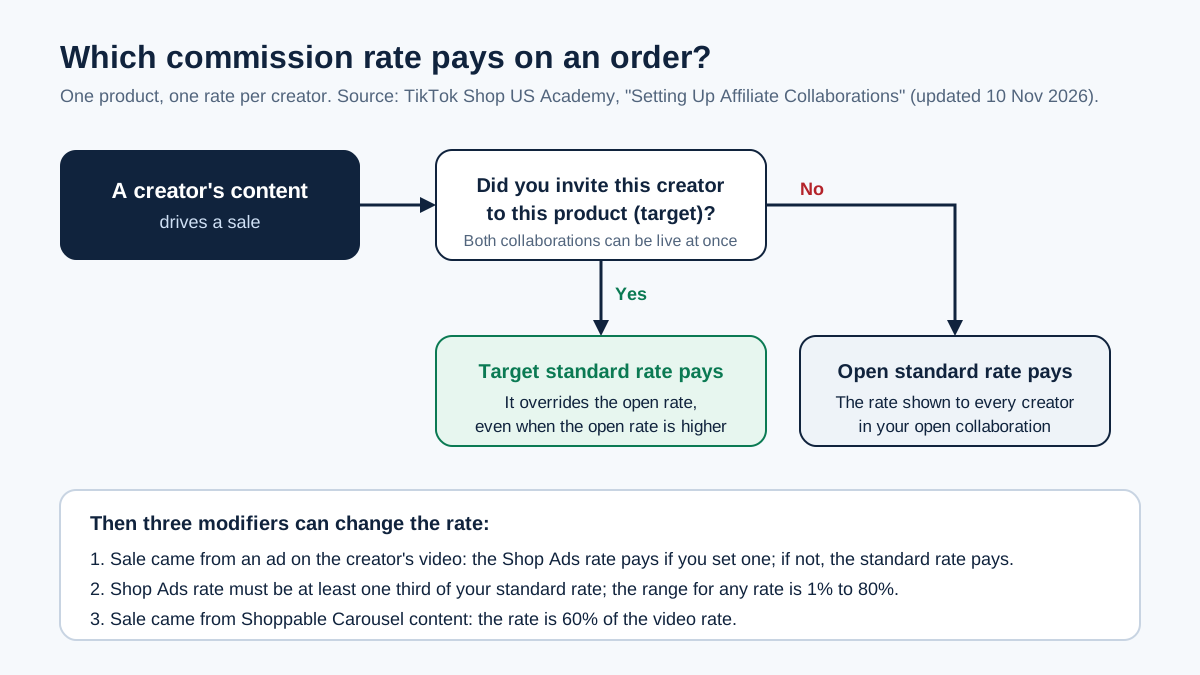
When one product sits in both an open and a target collaboration, the creator is paid one rate: the target rate, even if the open rate is higher. Shop Ads orders use the Shop Ads rate if you set one, and Shoppable Carousel content pays 60% of the video rate.
That is the rule from TikTok's affiliate collaboration guide, plus the carousel figure from How Standard Affiliate Commission Works.
Walk through a real order to see it. A creator you invited sells your product through a video. You have a target rate of 12% and an open rate of 18%. The creator earns 12%, not 18%. That override is "regardless of which is higher," in TikTok's wording.
Now add ads. TikTok has two rate types:
- Standard commission: what a creator earns on sales from organic content.
- Shop Ads commission: an optional, often higher rate for sales that come from authorized creator ads.
If you set no Shop Ads rate, ad-driven orders pay the standard rate. If you do set one, the platform requires it to be at least one third of your standard rate and will warn you if it is not.
Turning the Shop Ads rate off does not stop video shopping ads on a creator's content. TikTok says you must switch those off in TikTok Ads Manager.
When Do Creators Get Paid, and What Happens on a Refund?
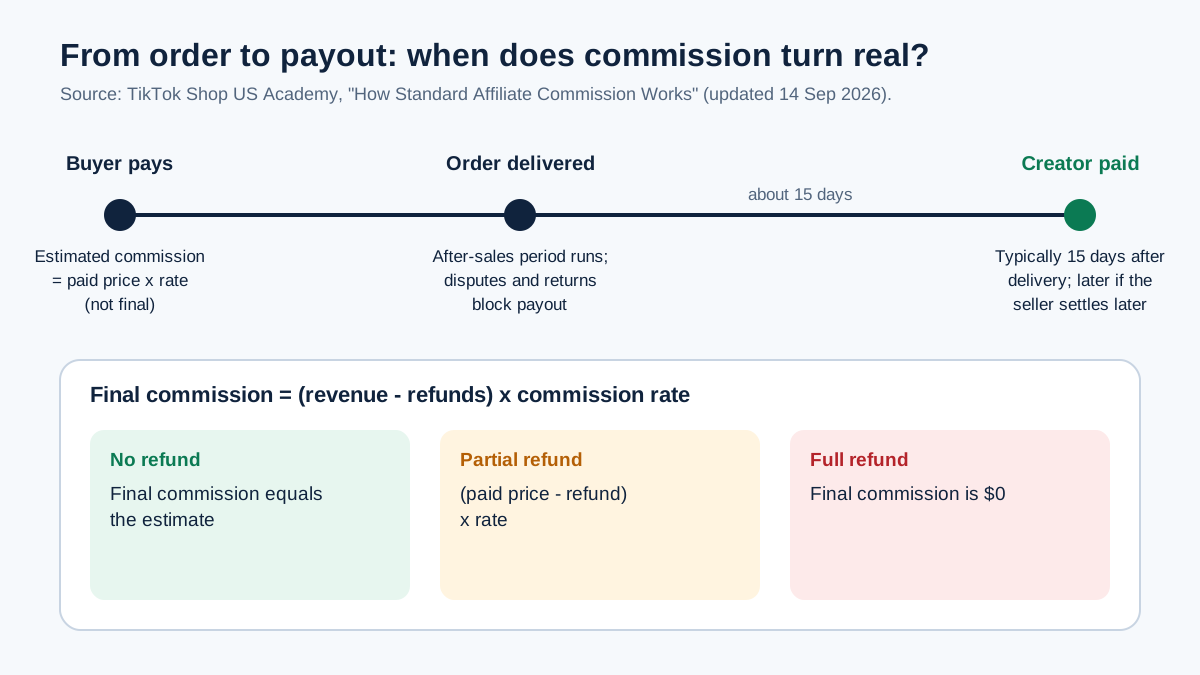
Creators typically receive affiliate commission 15 days after the order is delivered, and the final amount is (revenue minus refunds) times the rate. A partial refund reduces the commission, a full refund makes it $0, and a longer seller settlement period delays the payout.
This comes from How Standard Affiliate Commission Works, updated 14 September 2026.
The order matters for your cash flow and for creator trust. At purchase, the system shows an estimated commission based on the price paid. It is not final. After delivery and the after-sales window, the actual amount is set from what the buyer kept.
TikTok adds two delays worth knowing. Commissions are paid only after your order is settled, so if your settlement period is delivery plus 31 days, creators wait 31 days. And nothing is paid while a dispute, refund or return is open.
Refunds hit you on both sides, too. TikTok refunds the referral fee on a returned item minus a Refund Administration Fee of 20% of that fee, capped at $5 per SKU since 15 May 2025 (TikTok Shop referral fee policy). On a $500 item that cap matters. On a $10 item the fee is $0.12.
Does your commission setup match your real costs? Take the free Ecommerce Operations Scorecard to see where your multi-channel operations are weakest, including pricing and listing checks. About 2 minutes. Free. No pitch.
Can You Change a Commission Rate After Creators Start Promoting?
Yes, but TikTok Shop US protects creators for 30 days. A higher rate applies to creators already promoting the product immediately, while a lower rate only takes effect after their 30-day lock ends, with a 2-day warning on standard rates.
The rules are in How Standard Affiliate Commission Works. In practice they change how you test rates.
- Raising a rate is instant. Every creator already promoting the product gets the higher rate right away. The Seller Center shows you how many creators that affects.
- Lowering a rate is slow. Creators who already added the product keep their old rate until their 30-day window ends. New creators get the lower rate and keep it for their own 30 days.
- Shop Ads rates follow the same 30-day rule. The 2-day warning applies to standard rates only.
- A never-promoted product has no lock. If nobody has promoted it, a lower rate takes effect immediately.
- Creators lose the lock if they remove the product. Re-adding it later gives them the current rate.
The cost of a mistake is clear. If you launch at 35% by accident, you may pay 35% for 30 days on every order creators drive. Set rates after you cost them, not before.
What about tiered commissions?
Open collaborations also support tiered rates. You set up to two tiers based on order volume. TikTok's example is 10% for the first 100 orders and 15% after that.
The tiered commission guide lists the limits. Order thresholds cannot change once active. Rates can only go up. After you activate a tier you must wait 30 days before switching back to a fixed rate. Treat a tier as a one-way door.
How Do You Set a Rate That Still Leaves Margin?
Start from your profit, not from a competitor's rate. On a $40 order with a 6% referral fee, $14 product cost and $5 shipping, a 15% commission leaves $12.60 (31.5%), a 25% commission leaves $8.60 (21.5%), and break-even is 46.5%.
The referral fee comes from TikTok's policy page. The $40, $14 and $5 are illustrative numbers we chose to show the method. Replace them with yours.
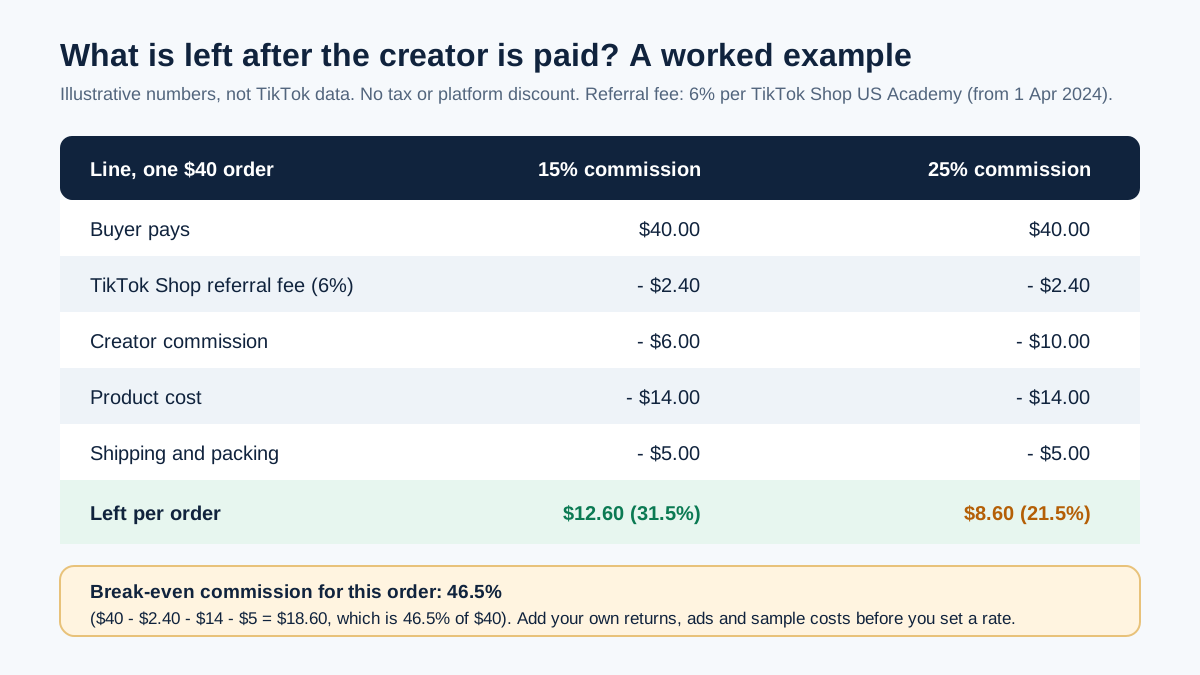
| Line, one $40 order | 15% commission | 25% commission |
|---|---|---|
| Buyer pays | $40.00 | $40.00 |
| Referral fee (6%) | -$2.40 | -$2.40 |
| Creator commission | -$6.00 | -$10.00 |
| Product cost | -$14.00 | -$14.00 |
| Shipping and packing | -$5.00 | -$5.00 |
| Left per order | $12.60 (31.5%) | $8.60 (21.5%) |
Illustrative figures. TikTok's referral fee baseline is buyer paid plus platform discount minus tax, so your own numbers will differ once discounts and tax apply.
Four steps keep this honest:
- Cost the order. Add product cost, shipping, packaging, the 6% referral fee and a returns allowance.
- Find your break-even rate. Subtract those from the price. In the example that is $18.60, or 46.5% of $40.
- Set a ceiling well below break-even. You need room for samples, ads and refunds. Where you set it is your call, based on your margin target.
- Compare with TikTok's category benchmark. If your ceiling sits below the recommended range, creators may pick other products. Fix the cost side before you chase creators with margin you do not have.
If you sell the same product on Shopee or Lazada, the math differs per channel. Our marketplace fee comparison and marketplace pricing strategy show how to keep one cost model across channels.
Who Qualifies for TikTok Shop Affiliate Marketing?
To use affiliate marketing, your shop needs a Shop Performance Score of 3.5 or above on a 0 to 5 scale, averaged over 90 days, and each product must pass its own checks. Creators need a Promotion Performance Score of 3.5 or higher and a Creator Health Rating of 150 or higher to promote products in designated categories.
Source: TikTok Shop's Affiliate Marketing Policy, updated 21 October 2026.
Shop qualification does not guarantee every product is enrolled. Each product is judged on its own. Its VoC Index (a measure of customer satisfaction across product quality, logistics and service) must be less than 1.5 times the average for its listing category. It also cannot have intellectual property, fair trading or customer-review violations, and it cannot be flagged as inauthentic.
TikTok can restrict affiliate access or remove products if you stop meeting these rules. That makes operations a commission issue, not just a service issue. A drop in shop score can put at risk a channel you pay creators to build.
Creator thresholds vary by category, so a creator who qualifies for one product type may be declined for another. If an invitation does not seem to land, look at that before you change the rate.
What Should You Check Every Week?
Review affiliate performance weekly, not at launch only. TikTok's Product Growth Suggestions label products "Top Selling" above 1,500 creator orders in 30 days and "Potential Top Selling" at 200 to 1,500, so you can see where a rate change or sample offer could pay off.
Those thresholds are in the affiliate collaboration guide. They are TikTok's labels, not performance promises.
A simple weekly routine for an ops team:
- Rates: list every product's standard and Shop Ads rates and confirm none was changed by auto-add or a batch edit.
- Margin: recalculate break-even for any product whose cost, shipping or price moved.
- Stock: check inventory on products creators are actively promoting, because a stock-out stops sales and wastes the creator's content.
- Health: confirm your Shop Performance Score still clears 3.5.
- Settlement: note which orders are waiting on disputes or returns so payouts are not a surprise.
This is exactly the kind of repeatable check that slips when it lives in one person's head. It is also what TaskForce is built for: daily checklists with proof, plus audits that flag pricing and stock problems across channels. If you manage TikTok Shop next to Shopify, Shopee or Lazada, see how TikTok Shop automation works and where the TikTok Shop seller guide fits in.
What Must Creators Disclose When They Promote Your Product?
Creators must disclose a material connection to a brand, such as payment or free products, clearly and conspicuously when the audience would not expect it. That is the rule in the Federal Trade Commission's Endorsement Guides, 16 CFR 255.5, and it covers free samples as well as commission.
Source: 16 CFR 255.5, Disclosure of material connections. The text says material connections include "monetary payment or the provision of free or discounted products," whether or not the advertiser requires an endorsement in return.
This is mostly the creator's duty, but it affects you. A brief that tells creators how to disclose, and a review of the content you pay for, protects the brand. If you offer free samples in a target collaboration, treat disclosure as part of the brief. We are not lawyers; check the rule text and your counsel for your case.
Frequently Asked Questions
What is the TikTok Shop affiliate commission rate?
There is no single rate. Sellers set their own from 1% to 80% per product on TikTok Shop US. TikTok suggests the median rate of the top 30% of products in your category over 30 days. Your Seller Center shows the suggested rate or range for each product.
How much does TikTok Shop take on top of affiliate commission?
TikTok Shop charges sellers a referral fee of 6% per qualified order in the US since 1 April 2024, though some categories differ. That fee is separate from the creator's commission. On a $40 order, the referral fee is $2.40 before any creator payment.
When do TikTok Shop affiliates get paid?
Creators typically get paid 15 days after the order is delivered. Payment waits for the seller's settlement, so a delivery plus 31 days settlement period means a 31-day wait. Open disputes, refunds or returns also delay payment, and a full refund reduces the commission to $0.
Can I lower my affiliate commission at any time?
You can edit it, but creators already promoting the product keep their old rate for 30 days. A higher rate applies immediately. If no creator has promoted the product yet, a lower rate takes effect straight away. Tiered commission rates can only be increased.
Do I need a minimum shop score to offer affiliate commission?
Yes. TikTok Shop's Affiliate Marketing Policy requires a Shop Performance Score of 3.5 or above, based on your average over the last 90 days. Each product must also pass its own VoC Index and policy checks before it can be enrolled.
Keep Reading
- TikTok Shop Seller Guide: Everything you need to start on TikTok Shop
- TikTok Shop vs Shopee: Compare fees, traffic and tools
- Marketplace Fee Comparison: Fees across the main marketplaces
- Marketplace Pricing Strategy: Price across channels without a race to the bottom
A commission rate is only as safe as the operations behind it. If you want to see where your multi-channel operations stand, take the Ecommerce Operations Scorecard. It takes about 2 minutes and shows you what to fix first.
Find out what your operation is missing
Answer 10 questions. Get your ops score. Takes 2 minutes.
Take the Scorecard