

How strong are your e-commerce ops? Take the 2-min scorecard.
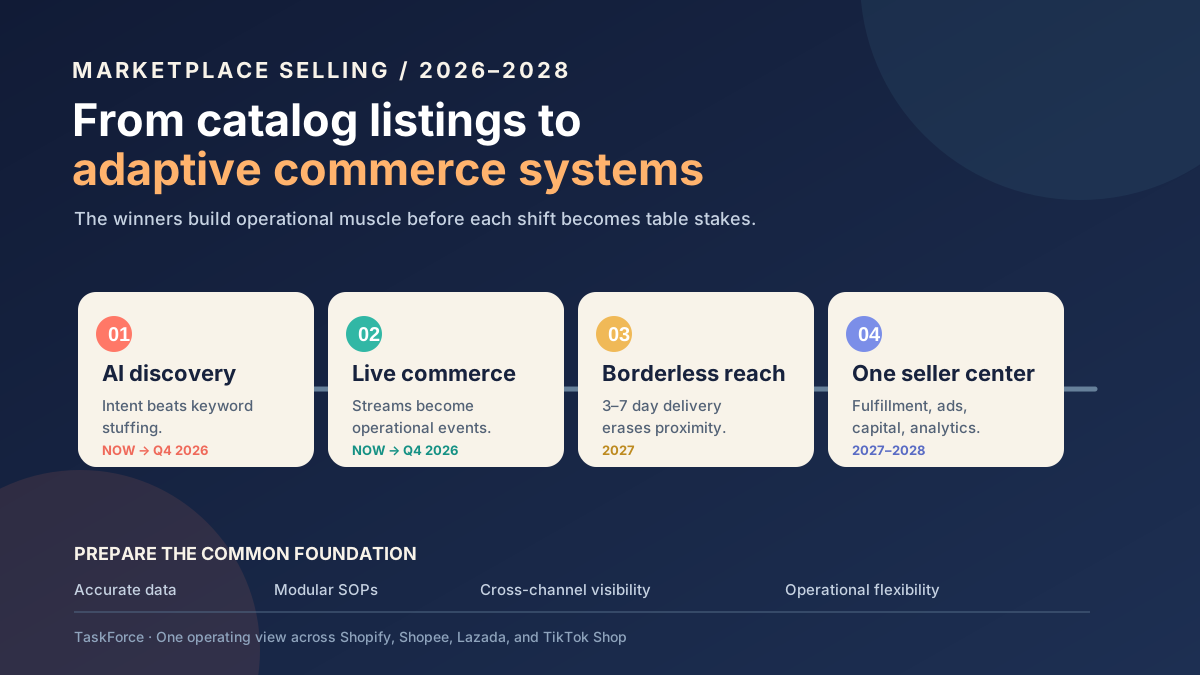
Score Your OpsMarketplace selling is mid-shift. The platforms that sellers built their businesses on in 2020 look fundamentally different in 2026 — and the next two years will accelerate the change. AI-driven search is rewriting how products get discovered. Live commerce has moved from novelty to revenue channel. Cross-border logistics now lets a seller in Kuala Lumpur compete directly with a warehouse in Shenzhen. And the marketplaces themselves are consolidating features that used to require a stack of third-party tools.
This is not a trend report full of speculation. It is a practical guide for ecommerce operations teams selling on Shopify, Shopee, Lazada, and TikTok Shop who need to understand what is changing and what to do about it.
What Is the Future of Marketplace Selling?
The future of marketplace selling is a shift from catalog-based discovery to AI-mediated, content-driven, operationally complex multi-channel commerce — where the sellers who win are the ones with the strongest operational systems, not the largest ad budgets.
Five years ago, marketplace selling was relatively simple: list products, run ads, ship orders. The seller with the best keywords and the highest ad spend won the buy box. That model is eroding. Marketplace algorithms now weigh seller health, content quality, fulfillment speed, and customer engagement alongside traditional signals like price and reviews.
The future rewards operational excellence over brute-force spending. That is good news for well-run teams and bad news for sellers who depend on ad arbitrage.
How Is AI Search Changing Product Discovery?
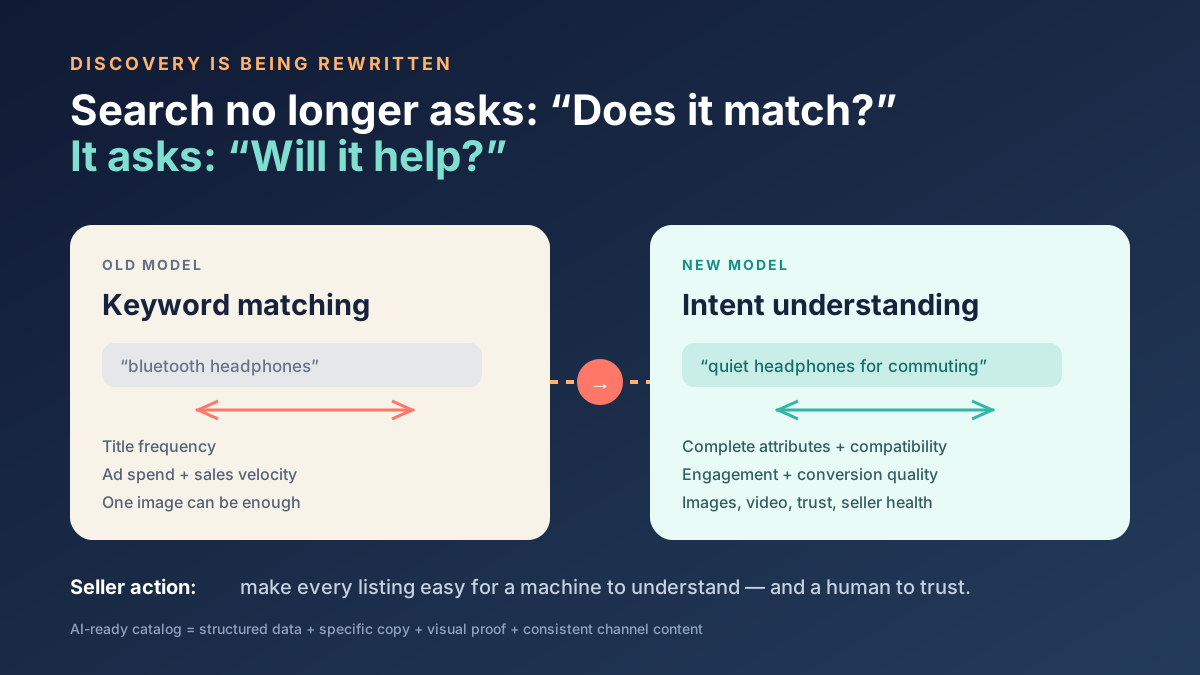
AI-powered search replaces keyword matching with intent understanding — which means your product data strategy matters more than your keyword stuffing strategy.
Traditional marketplace search worked like a database query: customer types "bluetooth headphones," algorithm matches products with those words in the title, sorts by relevance score (heavily influenced by ad spend and sales velocity). This model is fading.
What AI Search Looks Like Now
Shopee and Lazada have already deployed AI-powered search and recommendation systems. TikTok Shop's entire discovery model is algorithmic — products surface through the For You feed, not through search. Even Shopify's native search is moving toward semantic understanding.
The practical implications:
| Old Model (Keyword Search) | New Model (AI Search) |
|---|---|
| Title stuffing with keywords improves ranking | Natural, descriptive titles with accurate attributes perform better |
| Generic descriptions with repeated keywords | Rich, specific product descriptions that answer buyer questions |
| One image is enough if the title is right | Multiple high-quality images and video improve recommendation scores |
| Reviews are the primary trust signal | Seller health metrics, return rates, and response times are weighted equally |
| Ad spend dominates ranking | Organic signals (engagement, conversion rate, content quality) carry more weight |
What Sellers Should Do Now
Audit your product data. AI search systems parse structured attributes (material, size, use case, compatibility) more effectively than keyword-stuffed titles. Ensure every listing has complete, accurate attributes filled in — not just the required ones.
Invest in product imagery. AI recommendation engines increasingly use visual similarity. Products with multiple angles, lifestyle images, and video content get more algorithmic surface area. A single white-background product photo is no longer sufficient.
Monitor your content across channels. When AI systems pull different product data from different channels, inconsistency hurts. A product described as "wireless" on Shopee but "Bluetooth" on Lazada may not get cross-referenced correctly by comparison engines. Content drift detection — flagging when the same product diverges across channels — becomes operationally critical. Read more about managing this in the ecommerce compliance guide.
Track new ranking signals. Seller health scores, chat response rates, return rates, and fulfillment speed are becoming ranking inputs, not just account health metrics. The operations KPIs that used to be internal benchmarks now directly affect your search visibility.
How Is Live Commerce Reshaping Sales Channels?
Live commerce is not a marketing gimmick — it is a conversion channel with 3-5x the conversion rates of static listings, and it requires dedicated operational processes that most seller teams have not built yet.
TikTok Shop proved the model. Shopee Live followed. Lazada LazLive is gaining traction across Southeast Asia. Even Shopify merchants are integrating live selling through third-party tools. By 2027, McKinsey estimates live commerce will represent 10-20% of total ecommerce revenue in Southeast Asian markets.
The Operational Challenge
Live commerce introduces operational complexity that static listing sellers have never dealt with:
- Inventory reservation — Products promoted during a live stream need inventory held in real time. Overselling during a stream tanks your seller metrics.
- Fulfillment spikes — A successful stream generates hundreds of orders in minutes. Your warehouse needs to handle that surge within marketplace SLA windows.
- Content production — Streams require planning, scripts, product preparation, and post-stream analytics review. This is a recurring operational process, not a one-time marketing effort.
- Multi-stream coordination — Selling on Shopee Live and TikTok Shop Live simultaneously requires separate streams, separate inventory holds, and potentially separate hosts.
What Sellers Should Do Now
Build live commerce SOPs. Pre-stream preparation (inventory check, product staging, equipment test), during-stream operations (order monitoring, inventory updates, chat moderation), and post-stream procedures (order processing, analytics review, content repurposing). These need to be documented and repeatable, not improvised each session.
Integrate live commerce into your operational rhythm. Live streams are not marketing events — they are operational events. Add them to your daily operations checklist and campaign calendar. Pre-stream inventory verification prevents the disaster of selling 200 units of a product you have 50 of.
Track live commerce metrics separately. Conversion rate, average order value, viewer-to-buyer ratio, return rate (live commerce return rates tend to be higher than static listings), and fulfillment speed post-stream. These metrics feed back into your stream planning.
How Is Cross-Border Commerce Evolving?
Cross-border fulfillment infrastructure is erasing the advantages of local sellers — which means competing on operations and customer experience matters more than competing on proximity.
The logistics networks that enable cross-border selling have matured dramatically. Shopee's cross-border logistics program, Lazada's global fulfillment network, and TikTok Shop's expansion of seller eligibility across markets mean that a seller in China can reach Malaysian consumers with 3-5 day delivery — timeframes that were 14+ days just three years ago.
What This Means for Local Sellers
| Factor | 2023 | 2026+ |
|---|---|---|
| Cross-border delivery speed | 10-21 days | 3-7 days |
| Cross-border return handling | Painful and slow | Marketplace-managed local returns |
| Price competitiveness | Local sellers had margin advantage | Cross-border sellers often match or undercut |
| Customer trust in cross-border | Low — worried about quality and returns | Rising — marketplace guarantees reduce risk |
| Seller health requirements | Lower for cross-border | Converging with local seller standards |
This is not a doom scenario for local sellers. It is a strategic reality that requires a response.
What Sellers Should Do Now
Compete on service, not just price. Cross-border sellers can match your price. They cannot match same-day dispatch, local language customer service, and 24-hour return processing. Build these into your operational capabilities and highlight them in your listings.
Diversify across channels. Dependence on a single marketplace is riskier when that marketplace is actively expanding cross-border seller access. Selling across Shopee, Lazada, TikTok Shop, and your own Shopify store distributes risk. Multi-channel operations are more complex, but the ecommerce checklist provides a framework for managing that complexity.
Optimize your fulfillment speed. Marketplace algorithms increasingly reward fast fulfillment. If cross-border sellers deliver in 5 days and you deliver in 3, the algorithm favors you — but only if your delivery metrics are consistent. One late shipment per week erases the advantage.
Use local market knowledge. You understand local holidays, language nuances, sizing preferences, and cultural context better than a cross-border seller. Build this into your content strategy and customer service approach.
How strong are your ecommerce operations? Score your ops in 2 minutes — Take the free scorecard. No signup required.
How Is Platform Consolidation Affecting Sellers?
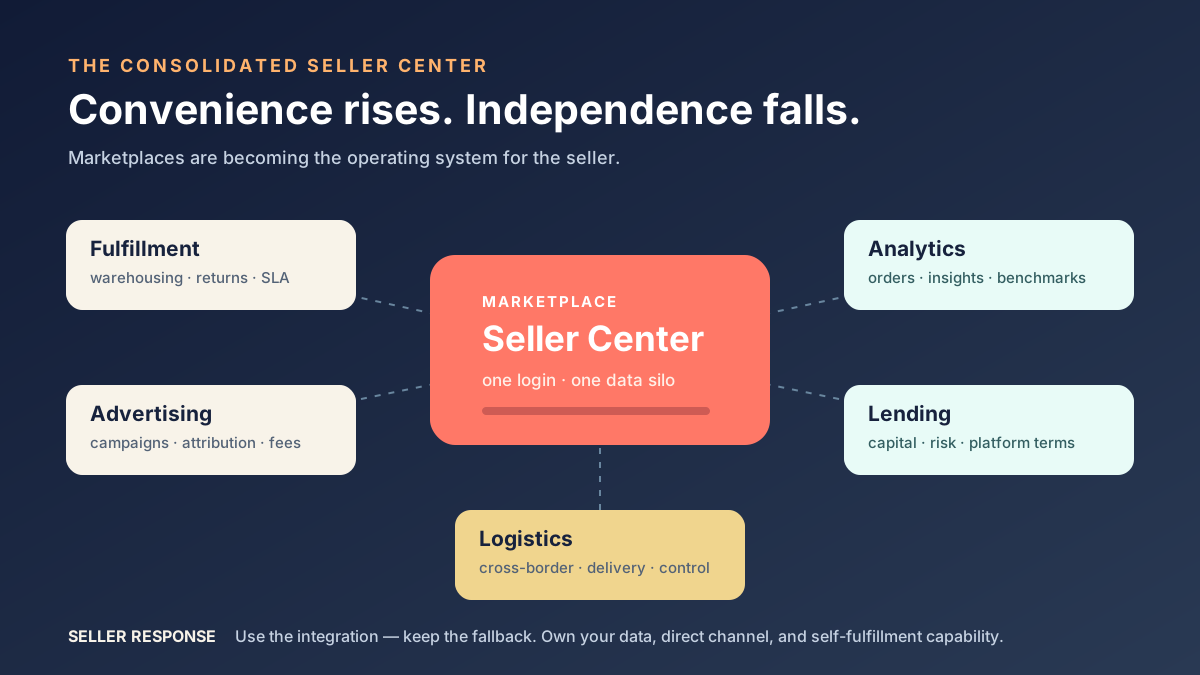
Marketplaces are absorbing functions that used to require third-party tools — from fulfillment to advertising to analytics — which simplifies some operations but increases platform dependency.
Shopee now offers warehousing, lending, advertising, analytics, and fulfillment as integrated services. Lazada's seller center has expanded from a listing tool to a full business management platform. TikTok Shop bundles content creation tools, analytics, affiliate management, and fulfillment into one ecosystem. Shopify has been on this trajectory for years with Shopify Fulfillment Network, Shopify Capital, and built-in analytics.
The Double-Edged Sword
The upside: fewer tools to manage, tighter integration between listing-advertising-fulfillment, lower operational overhead for simple setups.
The downside: deeper platform lock-in, less visibility into aggregate performance across channels, and reduced negotiating power when the marketplace is also your logistics provider, lender, and advertising platform.
What This Means Operationally
| Consolidation Trend | Operational Impact | Seller Response |
|---|---|---|
| Marketplace-managed fulfillment | Less control over packaging, shipping speed, returns handling | Monitor fulfillment quality metrics; maintain backup fulfillment capability |
| Integrated advertising | Simpler campaign management but less transparency on ROAS | Track true ROAS including marketplace fees, not just platform-reported metrics |
| Built-in analytics | Convenient but channel-siloed | Maintain cross-channel analytics for aggregate business view |
| Marketplace lending | Fast capital but tied to platform performance | Diversify funding sources; don't over-leverage on one platform's terms |
| AI-powered listing tools | Faster listing creation but homogenized content | Use platform tools as a starting point, then differentiate with custom content |
What Sellers Should Do Now
Maintain operational independence. Use marketplace fulfillment where it makes sense, but keep the capability to self-fulfill. Sellers who went all-in on a single marketplace's fulfillment program and then lost their account had no fallback.
Build cross-channel visibility. When each marketplace provides its own analytics dashboard, your business view is fragmented. You need a layer that aggregates performance, inventory, and operational metrics across all channels. This is the core problem that TaskForce solves — giving you one operational view across Shopify, Shopee, Lazada, and TikTok Shop.
Track total cost of marketplace services. Fulfillment fees, commission rates, advertising costs, and lending rates add up. Calculate your true margin per channel, per product, including all marketplace service costs. If your Shopee margin is 5% after fees but your Shopify margin is 25%, that shapes your channel strategy.
What Other Trends Should Sellers Watch?
Social Commerce Integration
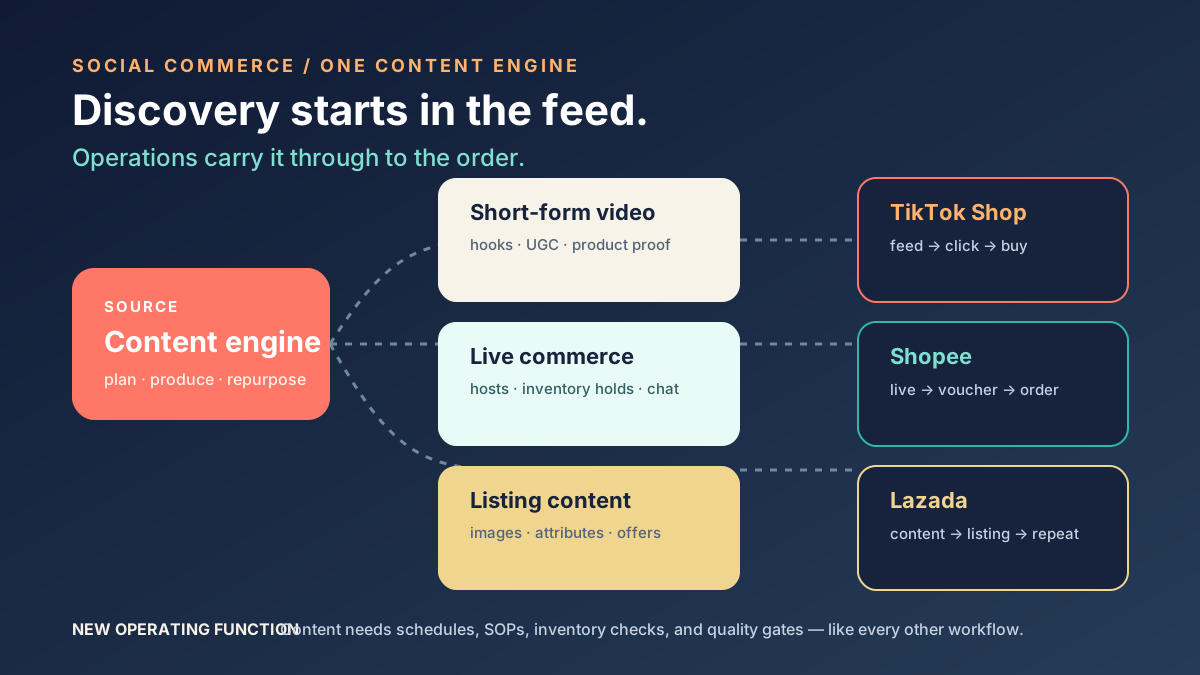
The line between social media and marketplace is blurring. TikTok Shop is the obvious example, but Shopee's integration with social features, Lazada's live commerce push, and Shopify's social selling integrations all point in the same direction: product discovery increasingly starts in social contexts, not search boxes.
Operational implication: Content creation — short-form video, live streams, user-generated content management — becomes an operational function, not just a marketing function. It needs SOPs, schedules, and quality checks like any other operational process. Statista's social commerce forecast projects continued double-digit growth in social-driven transactions through 2028.
Sustainability and Compliance Requirements
Marketplaces are adding sustainability requirements: packaging restrictions, carbon footprint labeling, and product compliance certifications. The EU's Digital Product Passport requirements will affect sellers shipping to European markets. Southeast Asian marketplaces are following with their own compliance frameworks.
Operational implication: Compliance documentation, product certification tracking, and packaging standards need to be built into your listing management and compliance procedures. This is not a one-time project — it is an ongoing operational responsibility.
Hyper-Personalization
Marketplace algorithms are moving toward personalized storefronts where two customers searching the same term see different product rankings based on their behavior history, preferences, and purchase patterns.
Operational implication: A/B testing listing content becomes more important because different versions may perform better for different audience segments. Conversion rate tracking needs to account for personalized traffic, not just aggregate numbers.
Subscription and Repeat Purchase Models
Marketplaces are building subscription features (Shopee's Subscribe & Save, Lazada's repeat purchase prompts). This changes inventory planning from demand forecasting to committed-demand management.
Operational implication: Subscription fulfillment requires more predictable inventory management. Stockouts on subscription orders damage customer lifetime value more than stockouts on one-time purchases. Your inventory and stock health processes need a separate track for subscription commitments.
How Should Sellers Prepare Their Operations for These Changes?
The sellers who thrive through marketplace evolution are not the ones who predict every trend correctly — they are the ones whose operational foundations are strong enough to adapt when the trends arrive.
Here is the preparation framework:
1. Audit Your Operational Foundation
Before worrying about AI search or live commerce, ensure your basics are solid. Orders processed within SLA. Inventory accurate across channels. Listings compliant with current rules. Customer inquiries answered within marketplace response windows. If these fundamentals are shaky, no amount of trend-chasing will help.
Use a structured ecommerce audit to identify gaps.
2. Build Modular SOPs
Write your operational procedures so they can be extended, not rewritten, when new channels or features emerge. A well-structured operations playbook has modular SOPs that you can duplicate and adapt for a new channel in days, not weeks.
3. Invest in Cross-Channel Visibility
The future is multi-channel, and managing each channel in its own silo creates blind spots. You need aggregated views of inventory, orders, seller health, and operational metrics. Whether you build dashboards manually or use an operations platform, cross-channel visibility is non-negotiable.
4. Train for Content Operations
Video production, live stream management, and social content creation are becoming operational functions. Build the team skills, equipment, and processes now rather than scrambling when your marketplace launches a live commerce incentive program.
5. Protect Operational Flexibility
Don't go all-in on one marketplace's ecosystem. Maintain the ability to self-fulfill, the ability to sell direct (Shopify), and the ability to pivot inventory between channels. Operational flexibility is insurance against platform risk.
The Timeline: What Changes When
| Timeframe | Change | Seller Impact | Preparation Priority |
|---|---|---|---|
| Now - Q4 2026 | AI search becomes default on major marketplaces | Product data quality directly affects ranking | High — audit and fix product attributes now |
| Now - Q4 2026 | Live commerce reaches 10%+ of GMV in SEA | Revenue opportunity for prepared sellers, risk for unprepared | Medium — build SOPs and test streams |
| 2027 | Cross-border delivery hits 3-day average in SEA | Local sellers lose proximity advantage | High — compete on service speed and quality |
| 2027 | Marketplace compliance requirements expand | Non-compliant listings get suppressed or removed | Medium — build compliance tracking into operations |
| 2027-2028 | Platform consolidation accelerates | Deeper lock-in, higher switching costs | Medium — maintain multi-channel presence and operational independence |
| 2028+ | Personalized storefronts become standard | Aggregate metrics become less meaningful | Low for now — focus on content quality and variant testing |
Frequently Asked Questions
Will AI replace marketplace sellers in Southeast Asia?
No. AI is changing how products get discovered, not eliminating sellers. What AI replaces is the value of keyword stuffing and generic listings. Sellers investing in accurate product data, quality imagery, and strong operational metrics will benefit from AI-powered discovery. According to Shopee's algorithm data, listings with complete attributes rank 2.3x higher under AI-driven search than minimal listings.
Should I invest in live commerce now or wait until it matures?
Start now, but small. Run 1 stream per week on your strongest channel and build operational procedures before scaling. McKinsey projects live commerce will represent 10-20% of Southeast Asian ecommerce revenue by 2027. The operational learning curve — inventory holds, fulfillment surges, content workflows — takes 3-6 months to develop, so starting later means catching up under pressure.
How do I protect my ecommerce business from marketplace platform risk?
Diversify across channels and maintain direct-to-consumer capability via Shopify or equivalent. Never let one marketplace exceed 60% of your revenue. Keep product content, customer data, and operational processes platform-independent. If forced to leave a marketplace tomorrow, you should be able to set up on another within 2 weeks — only possible if your operations playbook is organized and portable.
Is cross-border competition going to kill local marketplace sellers?
No, but it will eliminate local sellers competing only on proximity. Cross-border delivery has dropped from 14+ days to 3-7 days, erasing the geographic advantage. Local sellers must compete on fulfillment speed (same-day or next-day versus 3-5 day cross-border), local-language customer service, 24-hour return processing, and culturally relevant content that cross-border sellers cannot replicate effectively.
What is the single most important thing marketplace sellers should do to prepare?
Strengthen your operational foundation. Every trend — AI search, live commerce, cross-border competition, platform consolidation — rewards strong operations and punishes weak ones. Sellers with 98%+ inventory accuracy, on-time shipping above 95%, and documented SOPs can adapt to any marketplace change. Start with the complete ecommerce checklist and work through it systematically.
Keep Reading
- How to Build an Ecommerce Operations Playbook — The operational foundation that lets you adapt to marketplace changes
- Ecommerce Compliance Guide — Stay compliant as marketplace rules evolve
- Ecommerce Operations KPIs — The metrics that increasingly determine your marketplace visibility
- The Complete Ecommerce Checklist — From launch through scale, organized by phase
Find out what your operation is missing
Answer 10 questions. Get your ops score. Takes 2 minutes.
Take the Scorecard