

How strong are your e-commerce ops? Take the 2-min scorecard.
Score Your OpsShe messaged you on Shopee at 9 AM. By 9 PM, nobody had replied.
That 12-hour silence cost more than one lost customer. It moved your Shopee chat response rate below the threshold for Preferred Seller eligibility. It triggered a negative review that shows up on your most popular listing. And the customer — who had a simple sizing question — bought from your competitor instead.
Multi-channel customer service in ecommerce isn't a "nice to have." It's an operational function that directly impacts your marketplace seller scores, your conversion rates, and your ability to maintain premium seller status across platforms. Every unanswered message, every inconsistent response, and every unresolved dispute compounds into measurable revenue loss.
This guide covers how to manage customer support across Shopify, Shopee, Lazada, and TikTok Shop — the workflows, response strategies, and team structures that keep service quality high without requiring a dedicated support team for each platform.
What Is Multi-Channel Customer Service in Ecommerce?
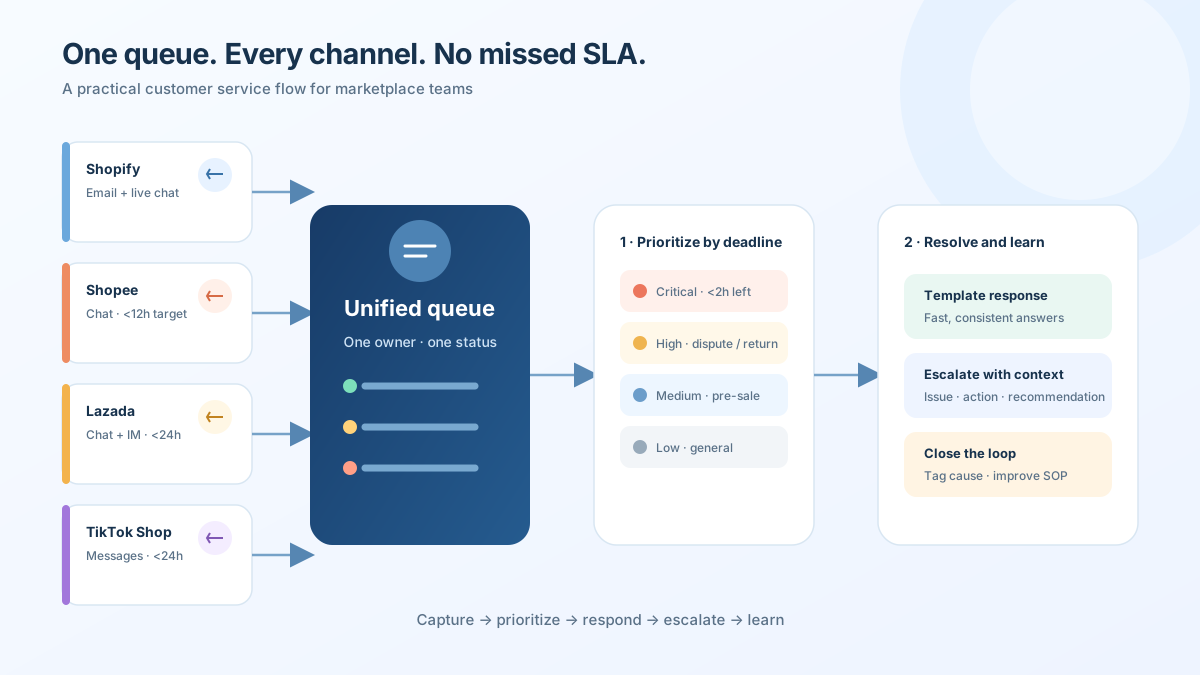
Multi-channel customer service is the practice of managing customer inquiries, complaints, returns, and disputes across every sales platform from a coordinated operation — with consistent quality and within each platform's required response times.
When you sell on one platform, customer service means monitoring one inbox. On Shopify, it's email and maybe a live chat widget. The response time expectations are set by you, and there's no algorithmic penalty for being slow.
Marketplaces changed this equation entirely. Each platform has:
- A built-in messaging system you must use (customers can't email you on Shopee)
- Response time requirements that affect your seller score
- Dispute resolution processes with platform-specific rules
- Review systems where unresolved complaints become permanent damage
The multi-channel challenge isn't just volume. It's that each platform has different rules, different customer expectations, and different consequences for poor service.
| Platform | Primary Support Channel | Response Time Requirement | Penalty for Slow Response |
|---|---|---|---|
| Shopify | Email, live chat (your tools) | Your SLA (no platform penalty) | Customer churn, reviews |
| Shopee | Shopee Chat | < 12 hours for response rate metric | Chat response rate drops, score impact |
| Lazada | Lazada Chat + IM | < 24 hours | Response rate metric, seller score |
| TikTok Shop | TikTok Shop messages | < 24 hours | Performance score impact |
Understanding these requirements is fundamental to running ecommerce operations across channels. Customer service isn't a separate function — it's woven into your marketplace health.
Why Does Multi-Channel Customer Service Break?
It breaks because teams manage each channel independently, creating inconsistent responses, duplicated effort, and invisible gaps where messages fall through the cracks.
The failure pattern has three stages:
Stage 1: Fragmentation. Each team member checks their assigned platform's messages when they have time. No shared view of what's been answered and what hasn't. If someone is out sick, their platform's messages sit unread.
Stage 2: Inconsistency. A customer asks about your return policy. The Shopee team member quotes 7 days. The Lazada team member quotes 14 days. Neither is checking the actual policy — they're going from memory. Now you have different promises on different platforms for the same product.
Stage 3: Escalation failure. A complex issue requires input from the fulfillment team or a decision from the manager. But the customer service person can't escalate effectively because there's no system — they send a WhatsApp message that gets buried in other conversations. The customer waits another day. The dispute escalates to platform intervention.
The root cause in every case: treating customer service as a channel-by-channel activity instead of a unified operation.
How Do You Build a Multi-Channel Customer Service Workflow?
Route all messages to a single queue, prioritize by SLA deadline, respond using templates for common issues, and escalate with structured handoffs for complex cases.
Step 1: Centralize Visibility
You don't necessarily need to pull all messages into one tool (marketplace messages often need to be answered within the platform). But you need a single view of message status across channels.
Options, from simplest to most sophisticated:
- Shared checklist — A daily Google Sheet where each platform's message count and oldest unread age are logged every 2 hours
- Helpdesk with marketplace integrations — Tools like Freshdesk, Zendesk, or Gorgias can pull Shopee and Lazada messages into a unified inbox
- Ops platform with monitoring — Built-in tracking of response times and SLA compliance across all connected channels
Step 2: Prioritize by SLA Deadline
Not all messages are equally urgent. Prioritize based on how close you are to the platform's response time penalty:
| Priority | Criteria | Response Target |
|---|---|---|
| Critical | Approaching SLA deadline (< 2 hours remaining) | Immediate |
| High | Customer dispute or return request | Within 2 hours |
| Medium | Pre-sale question on active listing | Within 4 hours |
| Low | General inquiry, post-delivery feedback | Within 8 hours |
This priority framework ensures you never miss an SLA deadline, even on high-volume days.
Step 3: Template Common Responses
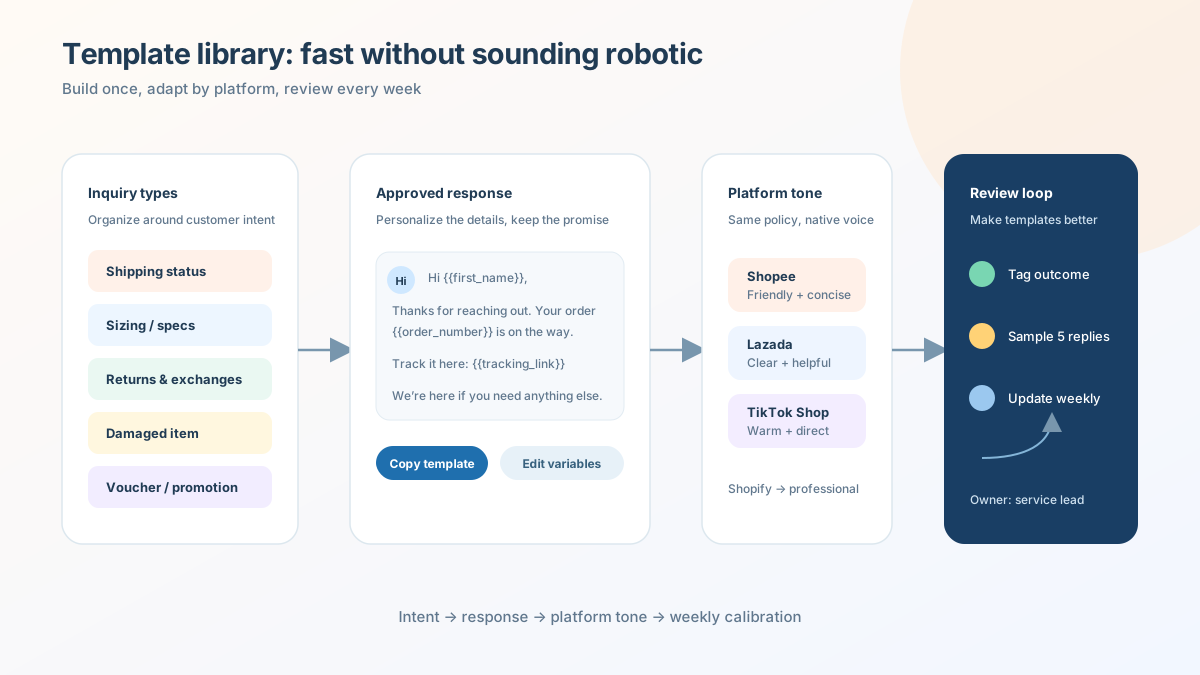
Analysis of ecommerce customer service data shows that 60-70% of customer inquiries fall into 10-15 categories. Build response templates for each:
- Shipping status inquiry
- Estimated delivery date
- Size/specification question
- Return/exchange process
- Damaged item report
- Wrong item received
- Cancellation request
- Promotion/voucher inquiry
- Product authenticity
- Bulk order inquiry
Templates should be platform-specific because each marketplace has different tone expectations and formatting options. A Shopee chat response is informal and uses the platform's emoji system. A Shopify email response is more professional and can include formatted HTML.
Step 4: Define Escalation Paths
When a template can't solve the problem, the service team needs a clear escalation process:
Level 1 (Service team): Standard inquiries, status updates, simple returns. Resolved with templates and basic order access.
Level 2 (Team lead): Complex returns, partial refunds, exceptions to policy. Requires judgment and access to override standard processes.
Level 3 (Operations manager / Founder): Platform disputes, legal threats, viral complaint potential, refund amounts over a threshold. Requires business-level decisions.
Each escalation should include: the customer's original message, what's been tried, and a recommended resolution. Never escalate a problem without a suggested solution.
How Do You Handle Returns and Disputes Across Channels?
Each marketplace has its own return and dispute process with specific timelines. Document the process per platform, train your team on each, and track resolution metrics to catch patterns early.
Returns and disputes are where customer service and operations intersect most directly. A return isn't just a service interaction — it triggers inventory adjustments, refund processing, and potentially a replacement shipment.
Return Process by Platform
| Step | Shopify | Shopee | Lazada | TikTok Shop |
|---|---|---|---|---|
| Customer initiates return | Email or form (your process) | Return/Refund button in app | Return/Refund button | Return/Refund button |
| Approval | Manual (you decide) | Auto-approved for most categories | Auto-approved with conditions | Auto-approved with inspection |
| Return shipping | Customer ships (your label or theirs) | Shopee arranges pickup | Lazada arranges pickup | Platform-managed |
| Refund trigger | You process after inspection | Auto-refund after tracking shows delivered | Auto-refund after delivered | Auto-refund after inspection |
| Timeline | Your policy (typically 30 days) | 7-15 days from delivery | 7 days from delivery | 15 days from delivery |
The operational challenge: your service team needs to know each platform's process. A customer asking about a return on Shopee gets a different answer than one asking on Lazada — not because your policy is different, but because the platform mechanics are different.
Dispute Prevention
Most disputes escalate because of slow responses, not because the underlying issue is unresolvable. Prevention tactics:
- Respond within 2 hours to any return or complaint message
- Proactively message customers when shipping is delayed
- Include tracking updates before the customer asks
- Offer resolution before the customer escalates to the platform
- Document everything — screenshots of conversations, tracking proof, photos of packed items
When a dispute does escalate to platform intervention, your documentation is your defense. The team with organized records wins disputes. The team that says "we shipped it, trust us" loses.
How strong are your ecommerce operations? Score your ops in 2 minutes — Take the free scorecard. No signup required.
What Metrics Should You Track for Multi-Channel Customer Service?
Track response time, resolution time, customer satisfaction (via reviews), and dispute rate by channel. These four metrics predict seller score health and customer retention.
Core Metrics Dashboard
| Metric | Target | Why It Matters |
|---|---|---|
| First response time | < 4 hours (all channels) | SLA compliance + customer satisfaction |
| Resolution time | < 24 hours (simple), < 72 hours (complex) | Prevents dispute escalation |
| Chat response rate | > 95% (Shopee), > 90% (Lazada) | Direct seller score input |
| Dispute rate | < 1% of orders | Platform penalties + revenue impact |
| Review response rate | 100% of negative reviews | Damage control + customer recovery |
| Repeat contact rate | < 20% | Issue actually resolved on first contact |
Weekly Service Review
Once per week, review:
- Message volume by channel — is one platform generating disproportionate service load? That might indicate a listing problem, not a service problem.
- Top inquiry categories — if 30% of messages are "where is my order," your tracking notification process needs fixing.
- Escalation frequency — if the same issue keeps escalating, the Level 1 response needs to be improved or the root cause needs to be addressed.
- Negative reviews — what caused them? Were they preventable? Is there a pattern?
This review turns customer service from a reactive function into a diagnostic tool. The inquiries your team receives are a real-time signal about what's working and what's broken in your operations.
Understanding why ecommerce brands fail often starts with the customer service data — it's the first place operational problems show up.
How Do You Scale Customer Service Without Scaling Headcount?
Automate the predictable (auto-responses, FAQ bots, shipping notifications), systematize the repetitive (templates, macros), and reserve human attention for the complex.
Automation Opportunities
| Task | Automation Method | Time Saved |
|---|---|---|
| "Where is my order?" | Auto-send tracking link when order ships | 30-40% of inquiries |
| Shipping delay notifications | Proactive message when carrier reports delay | Prevents 20-30% of complaints |
| FAQ responses | Chatbot or auto-reply for common questions | 15-20% of inquiries |
| Review requests | Automated post-delivery message | Generates reviews without manual outreach |
| Return status updates | Auto-update when return package is in transit | 10-15% of return-related inquiries |
Automating the "where is my order?" inquiry alone typically reduces customer service volume by 30-40%. Most ecommerce customer service teams spend a third of their time looking up tracking numbers that could be sent automatically.
Template Macros
For inquiries that need a human touch but follow a predictable pattern, use macros — saved responses that auto-fill customer-specific details (order number, product name, tracking link). A good macro library lets a service team member resolve 3-4x more inquiries per hour compared to typing every response from scratch.
Proactive Communication
The most effective way to reduce inbound service volume is to communicate proactively:
- Order confirmation with expected delivery date
- Shipped notification with tracking link
- Delivery delay alert before the customer notices
- Post-delivery check-in asking if everything arrived correctly
Each proactive message you send eliminates 2-3 inbound inquiries. The math is compelling: sending 100 automated shipping notifications prevents 60-90 "where is my order?" messages.
For a deeper look at how to structure these workflows, see our ecommerce team productivity guide — customer service automation is one of the highest-ROI investments.
How Do You Train a Customer Service Team for Multi-Channel?
Train on platform mechanics first (how each marketplace's chat and dispute system works), then on product knowledge, then on soft skills. Most training programs get this order backwards.
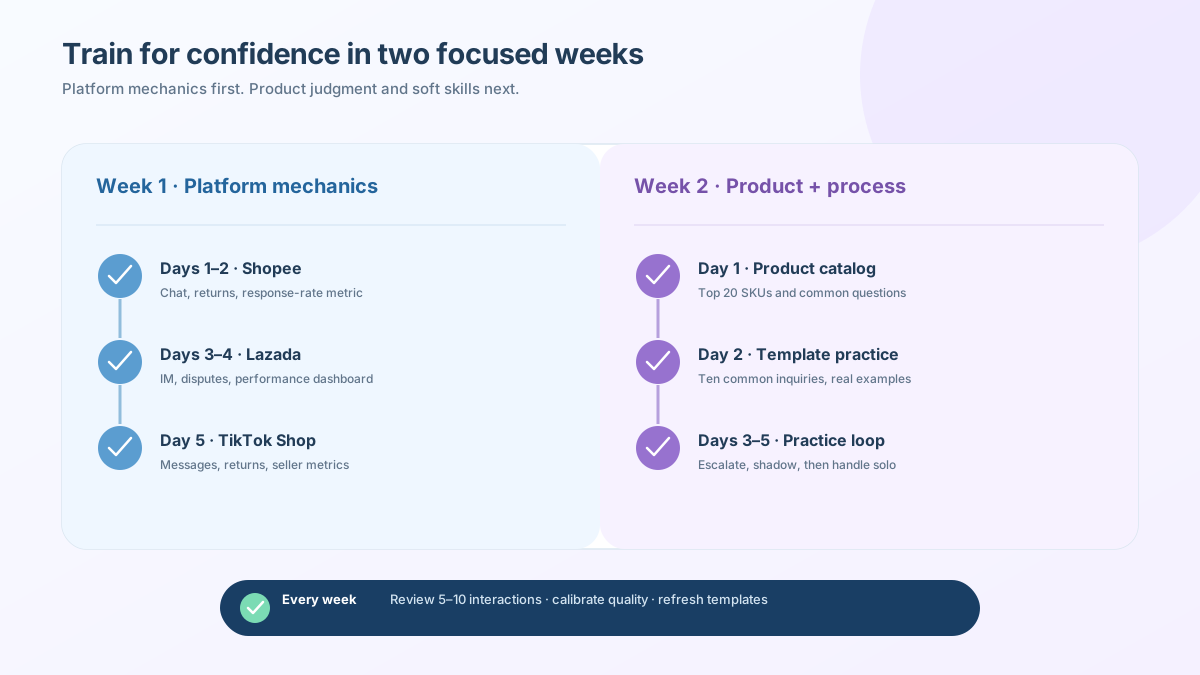
Training Curriculum (2 Weeks)
Week 1: Platform Mechanics
- Day 1-2: Shopee seller center — chat interface, return/refund flow, response rate metrics
- Day 3-4: Lazada seller center — IM system, dispute resolution, performance dashboard
- Day 5: TikTok Shop — messaging, return process, performance metrics
Week 2: Product and Process
- Day 1: Product catalog deep dive — top 20 SKUs, common questions, specifications
- Day 2: Template library — practice using templates for the 10 most common inquiries
- Day 3: Escalation process — when to escalate, how to document, who to contact
- Day 4: Live practice — shadow experienced team member, handle messages with supervision
- Day 5: Solo practice — independent message handling with daily review
Ongoing: Weekly calibration
- Review 5-10 random interactions per team member per week
- Identify quality gaps and retrain on specific areas
- Update templates based on new product launches or policy changes
What Tools Support Multi-Channel Customer Service?
Marketplace-native tools handle individual channel communication. Cross-channel helpdesks provide the unified view. Choose based on your volume — under 50 messages/day, native tools are sufficient.
| Tool Category | Examples | Best For | Limitation |
|---|---|---|---|
| Marketplace native | Shopee Chat, Lazada IM, TikTok messages | Low volume (< 50 msgs/day total) | No cross-channel view |
| Helpdesk with integrations | Freshdesk, Zendesk, Gorgias | Medium volume (50-200 msgs/day) | Integration quality varies by marketplace |
| SEA-specific helpdesks | Respondio, SleekFlow | SEA marketplace sellers | Smaller ecosystem, fewer integrations |
| Ops platform | TaskForce, custom internal tools | Teams wanting ops + service in one place | May require setup and configuration |
The decision comes down to volume and complexity. If you're handling 30 messages a day across three channels, switching between browser tabs is annoying but manageable. At 100+ messages per day, a unified tool isn't a luxury — it's a productivity multiplier.
How Do You Handle Negative Reviews Across Platforms?
Respond to every negative review within 24 hours with a specific acknowledgment of the issue, a concrete resolution, and a professional tone. Your response is for future buyers, not just the reviewer.
Negative reviews on marketplaces are permanent and public. Your response strategy matters because potential customers read review responses before buying.
Response Framework
- Acknowledge the specific issue — not a generic apology, but a direct reference to what went wrong
- Explain what happened — briefly, without excuses
- State the resolution — what you've done or will do to fix it
- Invite follow-up — offer a direct way to continue the conversation
Example for a late delivery complaint:
"We apologize that your order arrived 3 days later than expected. There was a carrier delay during the 11.11 period that affected shipments to your region. We've already added an extra item to your next order as a thank-you for your patience. Please message us directly if there's anything else we can help with."
This response works because it's specific, takes responsibility, offers a tangible resolution, and shows future buyers that you handle problems well.
Frequently Asked Questions
Can I use one customer service tool for all marketplaces?
Partially. Tools like Freshdesk and Gorgias can pull messages from Shopee and Lazada, but some interactions (disputes, return approvals) still need to happen in the marketplace's native interface. A helpdesk gives you centralized visibility and response management. It doesn't eliminate the need to use seller centers for platform-specific actions.
How do I maintain consistent service quality across channels?
Templates, training, and regular quality audits. Write response templates for every common inquiry category. Train every team member on every platform (not one person per platform). Review 5-10 random interactions per person per week to catch quality drift. Consistency comes from systems, not from hoping people will be consistent.
What's the best response time for marketplace customer service?
Under 4 hours during business hours. This keeps you well within platform SLA requirements (Shopee's 12-hour window, Lazada's 24-hour window) and is fast enough that most customers feel heard. Under 1 hour is better but only sustainable with dedicated service staff or automation handling the initial response.
How do I handle a customer who complains on multiple platforms simultaneously?
It happens. A frustrated customer posts a negative review on Shopee, messages on Lazada, and emails your Shopify store. Respond on every platform where they contacted you, but consolidate the resolution into one channel. "Thank you for reaching out. I can see your order and I'm handling the resolution here on Shopee. I'll update you within 24 hours."
Should I outsource customer service for my ecommerce business?
Not until your processes and templates are fully documented and tested. Outsourcing without documented processes means you're exporting your chaos to people with even less context. Once your service playbook is tight — templates for every scenario, escalation paths defined, metrics tracked — outsourcing can work well for standard inquiries while your in-house team handles escalations.
Keep Reading
- What Is Ecommerce Operations? — Customer service as part of the complete operational picture
- Why Ecommerce Brands Fail — Poor customer service is one of the 10 operational mistakes that kills growth
- Ecommerce Team Productivity — Workflows and structures for stretched ecommerce teams
Find out what your operation is missing
Answer 10 questions. Get your ops score. Takes 2 minutes.
Take the Scorecard