

How strong are your e-commerce ops? Take the 2-min scorecard.
Score Your OpsThe product sold itself. The brand still died.
That's the story nobody writes about on ecommerce Twitter. Founders love talking about product-market fit, ad creative, and brand building. Nobody posts about the stockout that cost them their Shopee Preferred Seller badge. Or the pricing error that sold 400 units at a loss. Or the warehouse that couldn't ship fast enough when the TikTok video went viral.
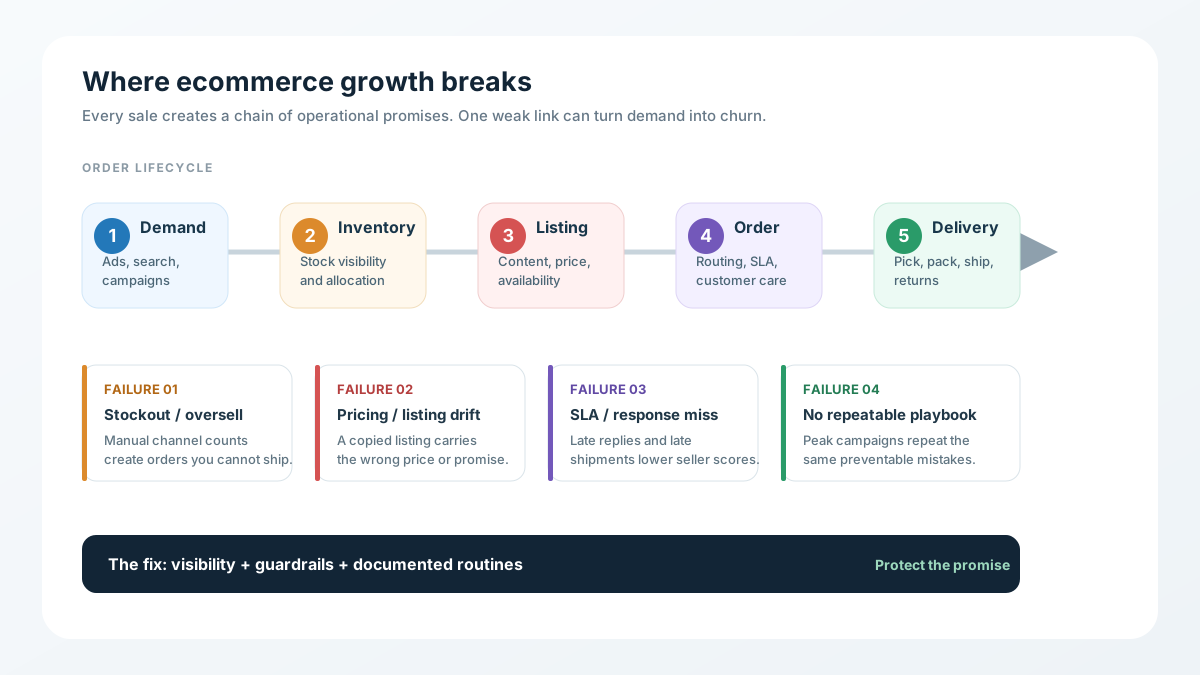
Ecommerce brands fail for operational reasons far more often than marketing ones. By the time you have consistent sales across Shopify, Shopee, Lazada, and TikTok Shop, the bottleneck isn't demand generation. It's your ability to deliver on the demand you've already created.
This guide documents 10 operational mistakes that kill ecommerce growth. Not theoretical risks — recurring patterns we see in brands selling across Southeast Asian marketplaces and Shopify. Each one includes what it looks like in practice, why it happens, and how to prevent it.
What Causes Most Ecommerce Brands to Fail?
Operational failure — the inability to consistently fulfill demand across channels — kills more ecommerce brands than bad products or weak marketing.
Industry data supports this. According to multiple analyses of failed ecommerce businesses, the top reasons consistently include inventory mismanagement, cash flow problems from operational inefficiency, and an inability to scale fulfillment. Product quality and market fit matter, but they're prerequisites. Once you've validated demand, operations becomes the constraint.
The 10 mistakes below are ordered roughly by how early they appear in a brand's lifecycle. Some are early-stage traps. Others only emerge when you're scaling past $50K/month in marketplace revenue.
Why Does Poor Inventory Visibility Kill Brands?
Brands that don't know their real-time stock position across channels will experience stockouts and overselling — it's not a question of if, but when.
This is the most common operational failure in multi-channel ecommerce. A brand sells on Shopify and Shopee. Inventory counts are updated manually, once a day, usually in the morning. By afternoon, a popular SKU sells out on Shopee but still shows as available on Shopify. Five Shopify orders come in. Three can't be fulfilled.
The downstream damage:
- Cancellation rate increases on Shopify (customer refund requests)
- Seller score drops on Shopee if the issue happens in reverse
- Customer trust erodes — they ordered something you couldn't deliver
- Team spends hours manually reconciling instead of growing the business
How to prevent it: Implement real-time inventory sync across all channels. This is the single highest-ROI operational investment for a multi-channel seller. Read the full breakdown of marketplace inventory management to understand the sync mechanisms and safety stock strategies.
What Happens When You Scale Channels but Not Operations?
Adding a new marketplace doubles your operational complexity. If you don't scale your processes to match, the new channel will degrade performance on your existing ones.
The pattern: a brand doing well on Shopify decides to add Shopee. Revenue increases by 40%. But now the same two-person team is managing listings, orders, customer service, and fulfillment across two platforms instead of one. Quality drops everywhere.
Listings on Shopee are copied from Shopify without optimization for the platform. Shopee's title format is different. Image requirements are different. The promotion mechanics are completely different. But there's no time to do it properly because the team is already underwater managing the existing Shopify workload plus the new Shopee orders.
| Operational Area | 1 Channel | 2 Channels | 4 Channels |
|---|---|---|---|
| Listing management | 1x effort | 2.5x effort | 6x effort |
| Inventory reconciliation | Simple | Moderate | Complex |
| Customer service | 1 inbox | 2 inboxes + chat | 4 inboxes + 2 chats |
| Order fulfillment | 1 label format | 2 label formats | 4 label formats + carrier rules |
| Promotions | 1 calendar | 2 calendars | 4 calendars, overlapping |
How to prevent it: Don't add a new channel until your operations on existing channels are running smoothly. Build the operational infrastructure — inventory sync, centralized order management, standardized fulfillment process — before adding complexity.
Understanding what ecommerce operations actually means helps teams see the full scope of work that multiplies with each new channel.
Why Do Teams Without SOPs Keep Making the Same Mistakes?
Without documented SOPs, every task is performed differently by every team member, every time. Errors become systematic because there's no standard to deviate from.
When the founder is the only person who knows how to process a Lazada return, create a Shopee campaign, or handle a customer complaint about a damaged item, the business can't grow beyond what the founder can personally touch.
SOPs don't need to be corporate-style 50-page manuals. They need to be:
- Written instructions for every repeatable task
- Accessible to the person performing the task
- Updated when the process changes
- Specific enough that a new team member can follow them without guidance
How to prevent it: Start with your five most frequent operational tasks. Write a one-page SOP for each. Test them by having someone else follow the instructions without your help. Fix the gaps. Then work down the list. Building an ecommerce operations playbook covers this process in detail.
What Happens When You Ignore Marketplace Health Metrics?
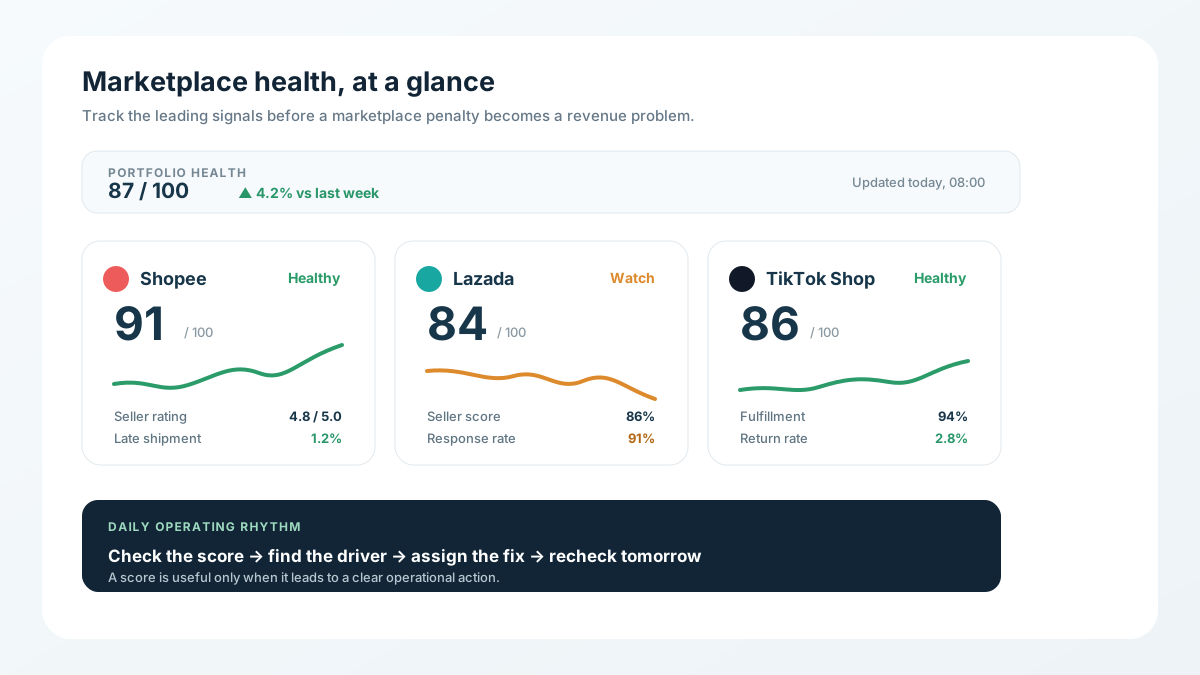
Marketplace seller scores directly control your visibility and revenue. Ignoring them is like ignoring your credit score while applying for loans.
Every Southeast Asian marketplace uses a seller scoring system that determines your search ranking, eligibility for promotions, and access to platform features:
| Marketplace | Health Metric | Key Factors | Consequence of Poor Score |
|---|---|---|---|
| Shopee | Seller Rating + Penalty Points | Late shipment, cancellation rate, response time | Loss of Preferred Seller badge, lower search rank |
| Lazada | Seller Score | Ship-on-time, cancellation, response rate | Reduced visibility, campaign exclusion |
| TikTok Shop | Seller Performance | Fulfillment speed, return rate, response time | Restricted features, potential suspension |
Brands that don't monitor these metrics daily often don't realize their score is declining until they've lost a badge or been excluded from a campaign. By then, the revenue impact is already happening.
How to prevent it: Check marketplace health scores every morning. Set up alerts for any metric approaching the penalty threshold. Track trends weekly. A 1% increase in late shipment rate today becomes a lost Preferred Seller badge next month if you don't catch it.
Why Does Manual Pricing Across Channels Backfire?
Manually updating prices on four platforms guarantees pricing errors. A pricing error on a marketplace during a flash sale can cost thousands in minutes.
A brand runs a 15% off promotion on Shopee but forgets to exclude a low-margin SKU. That SKU is now selling below cost. Or worse — a team member updates the Lazada price from $29.90 to $2.99 instead of $29.00. At marketplace scale, hundreds of units can sell at the wrong price before anyone notices.
Pricing across channels also needs to account for:
- Different commission structures (Shopee takes 6%, Lazada takes 4%, etc.)
- Platform-specific promotions that stack with your discount
- Currency differences (if selling cross-border)
- Minimum price rules that prevent you from pricing below cost
How to prevent it: Use a centralized pricing system with guardrails. Set minimum prices per SKU that prevent below-cost sales regardless of discounts applied. Implement approval workflows for price changes above a certain percentage.
Why Is Treating Customer Service as an Afterthought So Costly?
In marketplace ecommerce, customer service directly impacts your seller score. Slow responses don't just lose customers — they get you penalized by the platform.
Shopee requires a chat response within 12 hours to maintain your response rate metric. Lazada has similar requirements. TikTok Shop tracks response time as part of seller performance.
Brands that treat customer service as something to handle "when we have time" end up with:
- Declining response rate metrics leading to lower seller scores
- Negative reviews from unanswered complaints leading to lower conversion rates
- Refund disputes that escalate to platform intervention leading to penalty points
The compounding effect is brutal. A bad customer service experience leads to a negative review, which lowers conversion, which reduces sales velocity, which drops your search ranking, which reduces visibility, which further reduces sales. One unhappy customer can trigger a measurable revenue decline.
How to prevent it: Assign clear ownership for customer service on each channel. Set response time targets (under 4 hours during business hours). Use templates for common questions. Escalate complex issues rather than letting them sit.
How strong are your ecommerce operations? Score your ops in 2 minutes — Take the free scorecard. No signup required.
Why Does Skipping Demand Forecasting Drain Cash?
Brands that order inventory based on gut feeling instead of data either overstock (cash trapped in unsold products) or understock (lost revenue and damaged marketplace scores).
Inventory is the largest capital expenditure for most ecommerce businesses. Get it wrong in either direction and you lose:
- Overstock: Cash is locked in warehouse shelves. Storage costs accumulate. Products may become obsolete or expire. Eventually you're forced to discount heavily to clear, destroying margin.
- Understock: Out-of-stock listings get zero impressions. Marketplace algorithms demote products that are frequently unavailable. Customers buy from competitors and may not come back.
The fix isn't complex analytics. It starts with tracking three numbers per SKU:
- Average daily sales rate (by channel)
- Supplier lead time (order to warehouse)
- Safety stock buffer (typically 2-3 weeks of demand)
Reorder point = (Daily sales rate x Lead time) + Safety stock
That formula prevents most stockout emergencies. Advanced forecasting — accounting for seasonality, promotions, and trends — comes later.
Why Can't You Copy-Paste Listings Across Platforms?
A listing that converts on Shopify will underperform on Shopee because the platforms have fundamentally different search algorithms, buyer behaviors, and content formats.
Copy-pasting product listings across platforms is the default behavior for time-strapped teams. It's also a guaranteed way to underperform on every platform after the first one.
| Platform | Title Character Limit | Search Algorithm Priority | Image Requirements | Key Difference |
|---|---|---|---|---|
| Shopify | Unlimited (practical: 70) | Your own SEO/ads | Square, min 2048px | You control the experience |
| Shopee | ~120 characters | Keyword matching + sales velocity | Min 500x500, up to 9 images | Keyword-stuffed titles perform better |
| Lazada | ~120 characters | Keyword matching + seller score | Min 330x330, white background preferred | Category attributes heavily weighted |
| TikTok Shop | ~34 characters visible | Content engagement + sales | Square, lifestyle preferred | Short titles, video-first platform |
A product title that works on Shopify ("Minimalist Leather Wallet — Slim Bifold Design") needs to be rewritten for Shopee ("Leather Wallet Men Slim Minimalist Bifold RFID Blocking Genuine Leather") to match how Shopee's search algorithm works.
How to prevent it: Create platform-specific listing templates. Invest time optimizing titles, images, and descriptions for each platform's requirements. The effort pays for itself in higher search ranking and conversion rates.
Why Do Brands Without Playbooks Repeat the Same Failures?
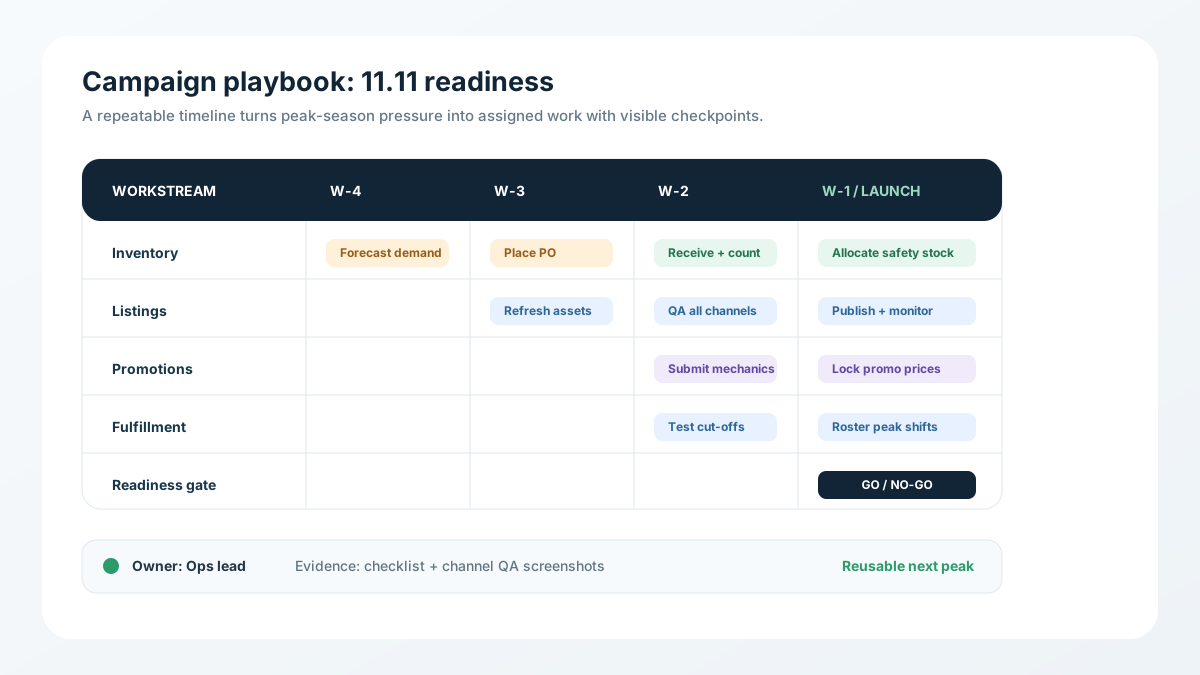
Without playbooks for product launches, campaign prep, and seasonal scaling, every major event is managed from scratch — with the same mistakes repeated each time.
The difference between a brand that executes a clean 11.11 campaign and one that's scrambling the night before: a playbook.
Repeatable processes that deserve documented playbooks:
- New product launch (listing creation, inventory positioning, promotion setup, launch)
- Campaign preparation (9.9, 10.10, 11.11, 12.12 and other sale events)
- New marketplace onboarding (account setup, listing migration, fulfillment configuration)
- Seasonal inventory planning (forecast, order, receive, position)
- Team member onboarding (access setup, training, certification)
Each playbook captures the steps, timeline, responsibilities, and lessons learned from previous executions. Without them, institutional knowledge lives in people's heads — and walks out the door when they leave.
How to prevent it: After every major operational event (campaign, launch, peak season), run a 30-minute retrospective. Document what worked, what broke, and what to change next time. That document becomes the playbook for the next event.
What Breaks When Revenue Scales but Systems Don't?
The systems that work at $20K/month break at $100K/month. Brands that don't upgrade their operational infrastructure before they need it hit a growth ceiling — or worse, a growth collapse.
This is the meta-mistake that encompasses all the others. Every operational shortcut that works at low volume becomes a liability at high volume:
- The spreadsheet that tracked inventory across two channels doesn't work across four
- The founder who personally handled every customer complaint can't do it at 200 messages/day
- The manual label printing process that worked at 30 orders/day breaks at 300
- The "we'll deal with returns later" attitude becomes a warehouse full of unprocessed returns
The brands that scale successfully invest in operational infrastructure ahead of revenue. They implement inventory sync before they need it. They hire and train before they're overwhelmed. They build SOPs before onboarding new team members.
How to prevent it: At every revenue milestone ($20K, $50K, $100K, $250K/month), audit your operational capacity. Ask: what breaks if volume doubles from here? Fix those things before the volume arrives.
Where Are You on the Operational Maturity Curve?
Most ecommerce brands fall on a predictable maturity curve. Knowing where you are helps you focus on the right improvements.
| Stage | Revenue Range | Characteristics | Priority Investments |
|---|---|---|---|
| Startup | $0-$10K/month | Founder does everything, manual processes | Product-market fit, first channel optimization |
| Growth | $10K-$50K/month | 2-3 team members, spreadsheet-based | Inventory sync, basic SOPs, second channel |
| Scale | $50K-$250K/month | Dedicated ops team, multiple channels | OMS, WMS, marketplace health monitoring |
| Maturity | $250K+/month | Specialized roles, automated workflows | Advanced analytics, process optimization, expansion |
The brands that die in the "Growth" stage almost always die from Mistakes #1-#5. The ones that stall in the "Scale" stage are usually hit by #6-#10.
How Do You Audit Your Own Operations?
A monthly operational health check using five leading indicators catches problems before they become crises.
You don't need a consultant to assess your operational health. Track these five numbers weekly:
- Cancellation rate — Are you overselling or failing to fulfill?
- Late shipment rate — Is your fulfillment keeping up with demand?
- Customer response time — Are you meeting marketplace SLA requirements?
- Inventory accuracy — Does your system match reality?
- Error rate — Wrong shipments, pricing mistakes, listing errors
If any of these trends upward for two consecutive weeks, you've identified which of the 10 mistakes is active in your business. Fix it before it compounds.
According to Shopee's seller education center, maintaining healthy operational metrics is the single most effective way to improve search visibility. Lazada's seller center resources echo this — operational health directly translates to marketplace performance.
Frequently Asked Questions
What's the #1 reason ecommerce brands fail?
Running out of cash, usually caused by one of two operational failures: overstocking (capital trapped in unsold inventory) or understocking (losing sales and marketplace ranking, then overspending on ads to recover). Both are inventory management problems. Get your stock position right and most cash flow crises are avoidable.
How do I know if my operations are holding back growth?
Look for these signals: rising cancellation rates, declining marketplace health scores, increasing customer complaints about shipping speed, team members working overtime to keep up with current volume, and errors that keep recurring. If you're spending more time firefighting than building, operations is your bottleneck.
Can small ecommerce teams compete with large operations?
Yes, but not by doing the same things manually. Small teams compete by being more focused (fewer SKUs, deeper optimization per channel), more automated (using tools to replace manual work), and more disciplined (following SOPs consistently). A two-person team with good systems can outperform a ten-person team running on chaos.
When should I invest in ecommerce operations tools?
When any single operational task takes more than 30 minutes per day of manual work. That's the threshold where tool costs are justified by time savings. Inventory sync should be your first tool investment, followed by centralized order management, then marketplace health monitoring.
How do I convince my team (or boss) to invest in operations?
Show the cost of not investing. Calculate the revenue lost from stockouts last month. Tally the penalty points from late shipments. Estimate the team hours spent on manual tasks that could be automated. Operations investment has measurable ROI — usually 3-5x within the first quarter.
Keep Reading
- What Is Ecommerce Operations? — The complete framework for operational excellence
- Marketplace Inventory Management — Fix Mistake #1 with proper inventory sync
- Building an Ecommerce Operations Playbook — Turn lessons into repeatable processes
Find out what your operation is missing
Answer 10 questions. Get your ops score. Takes 2 minutes.
Take the Scorecard