
How strong are your e-commerce ops? Take the 2-min scorecard.
Score Your OpsOrders are coming in from four platforms. That sentence alone explains why multi-channel fulfillment breaks most ecommerce operations before they reach 200 orders a day.
You sell on Shopify, Shopee, Lazada, and TikTok Shop. Each marketplace has a different shipping SLA. Shopee gives you two days. TikTok Shop wants same-day handover on some routes. Lazada penalizes late shipments with visibility demotion. Shopify customers expect the tracking number within hours because Amazon trained them that way.
Your warehouse team doesn't care which platform the order came from. According to McKinsey's supply chain operations research, warehouses handling multi-channel fulfillment see 23% higher labor costs when each channel is processed as an independent workflow versus a unified operation. They care about picking the right item, packing it correctly, and getting it to the right carrier before the cutoff time. But when your fulfillment process doesn't account for multi-channel complexity, small problems — a missed SLA here, a wrong carrier there — compound into late shipment rates that tank your seller scores.
This guide covers multi-channel fulfillment end to end. Warehouse setup, order routing, carrier selection, and the systems that hold it together when you scale past what manual processes can handle.
What Is Multi-Channel Fulfillment?
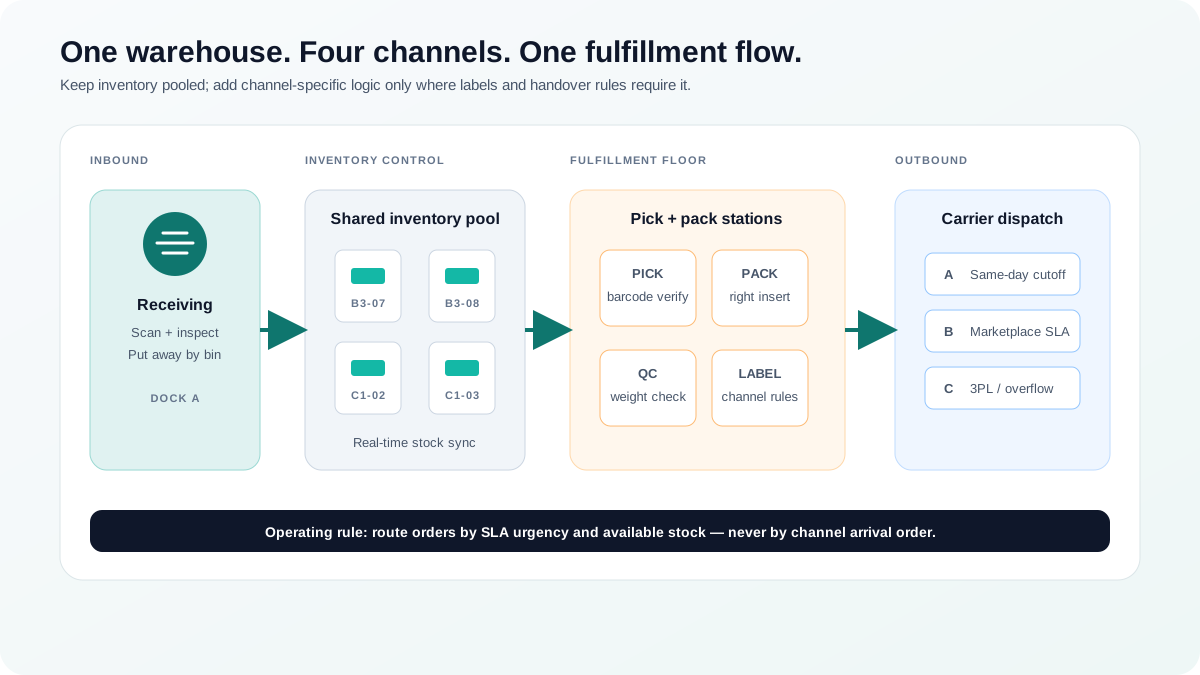
Multi-channel fulfillment is the process of receiving, picking, packing, and shipping orders that originate from multiple sales channels — using a single inventory pool and warehouse operation.
If you sell only on Shopify, fulfillment is straightforward. One order source, one set of shipping rules, one carrier integration. Multi-channel fulfillment adds layers of complexity because each platform has its own requirements for shipping labels, carrier assignments, packaging, and handover timing.
The core challenge isn't moving boxes. It's coordination. When an order comes in from Shopee at 2 PM, your system needs to know: which warehouse has the stock, which carrier meets the SLA, what label format does Shopee require, and can this order be batched with the Lazada orders shipping on the same truck?
Most teams start multi-channel fulfillment by accident. They add a second marketplace, handle the extra orders manually for a few weeks, and suddenly realize they've been shipping Shopee orders with Shopify packing slips. Or worse — they oversold because inventory wasn't synced between channels.
Understanding what ecommerce operations actually involves is the first step. Fulfillment is one of the six areas where operations either runs smoothly or falls apart.
Why Does Multi-Channel Fulfillment Fail?
It fails because teams treat each channel as an independent operation instead of building one fulfillment system that serves all channels.
The failure pattern is predictable. A brand starts on Shopify. Fulfillment works fine — orders come in, the team picks and packs, labels print from Shopify's shipping page. Then they add Shopee. Now someone has to log into Shopee's seller center, print Shopee labels separately, and mentally track which orders go to which carrier.
Add Lazada and TikTok Shop, and you've got four browser tabs open, four label formats, and a warehouse team that asks "which platform is this for?" on every order.
The specific failure modes:
| Failure Mode | What Happens | Impact |
|---|---|---|
| Inventory desync | Channel A shows stock, channel B already sold it | Overselling, cancellations, penalty points |
| SLA violations | Orders from fast-SLA channels processed in FIFO order | Late shipment rate increases, search ranking drops |
| Wrong carrier assignment | Shopee order shipped via non-Shopee logistics | Tracking doesn't update, buyer opens dispute |
| Label format errors | Shopify packing slip used for Lazada order | Return to sender, customer confusion |
| Split inventory | Separate stock reserved per channel | Higher total inventory needed, capital locked up |
| Batching failures | Each channel fulfilled separately | 2-3x more warehouse picks than necessary |
The root cause in every case: the fulfillment process was designed for one channel and then stretched — not redesigned — for multiple channels.
How Should You Set Up a Multi-Channel Warehouse?
Design the warehouse around the pick-pack-ship workflow, not around which platform the order came from. Channel-agnostic storage with channel-aware packing stations is the model that scales.
Your warehouse layout determines your fulfillment speed ceiling. Here's how to set it up for multi-channel operations.
Storage: Channel-Agnostic
All inventory lives in the same locations regardless of which channel it sells on. SKU A-1234 sits in bin B3-07 whether it's allocated to a Shopify order or a Shopee order. This is non-negotiable for efficient multi-channel fulfillment.
The alternative — reserving inventory by channel — means you need more total stock to achieve the same fill rate. If you reserve 50 units for Shopify and 50 for Shopee, and Shopify sells 60 while Shopee sells 30, you've got 20 idle units on Shopee and 10 stockouts on Shopify. Pooled inventory solves this.
Picking: Batched by Location, Not by Channel
Efficient picking means minimizing travel distance. When your order management system groups picks by warehouse zone rather than by sales channel, one walk through the warehouse can fulfill orders from all four platforms.
A batch pick for 40 orders across all channels is faster than four separate picks of 10 orders each — especially when those orders share popular SKUs.
Packing: Channel-Aware Stations
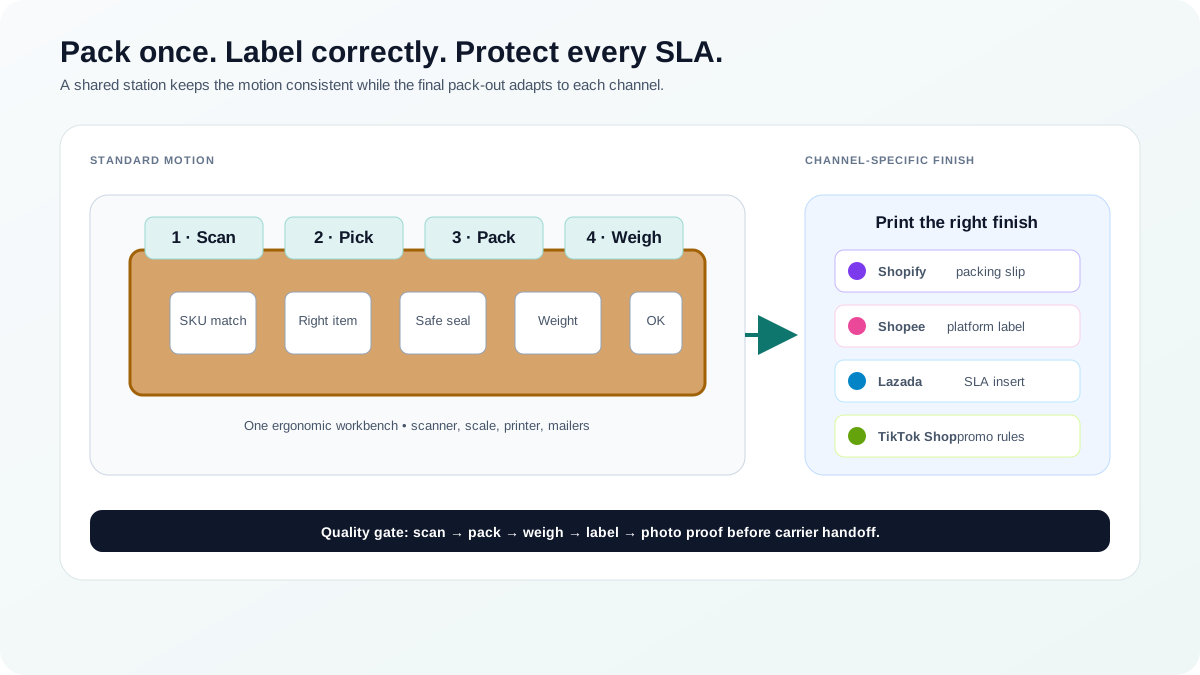
This is where channel specificity matters. Each packing station needs access to the correct label printer, packing slip format, and insert materials for each channel. Some teams use dedicated stations per channel during high volume. Others use a single station with software-driven label selection.
The packing station workflow:
- Scanner reads the pick bin barcode
- System identifies the order and source channel
- Correct shipping label prints automatically
- Channel-specific packing slip or insert is added
- Package is routed to the correct carrier staging area
Staging: Carrier-Sorted
After packing, orders are staged by carrier, not by channel. All Shopee Xpress packages go to one area. All J&T packages go to another. This simplifies carrier pickup and reduces the chance of packages ending up on the wrong truck.
If you're managing inventory across marketplaces, the warehouse layout is where theory meets reality. The best inventory sync in the world doesn't matter if your warehouse can't physically process the orders fast enough.
What Multi-Channel Fulfillment Models Exist?
Three models dominate: self-fulfillment from a central warehouse, marketplace-managed fulfillment (like Shopee Fulfilled), and third-party logistics (3PL). Most multi-channel sellers use a hybrid.
Each model has tradeoffs. The right choice depends on your order volume, SKU count, and which marketplaces drive the most revenue.
| Fulfillment Model | Best For | Pros | Cons |
|---|---|---|---|
| Self-fulfillment (in-house) | High-volume sellers with 500+ orders/day | Full control, lower per-unit cost at scale | Requires warehouse staff, space, and systems |
| Marketplace-managed (Shopee Fulfilled, Lazada FBL) | Sellers wanting search ranking boost on that platform | Better visibility, faster delivery promise | Inventory locked to one channel, fees add up |
| 3PL | Brands scaling fast without warehouse infrastructure | No warehouse overhead, scales quickly | Less control, per-order fees eat margins |
| Hybrid | Most multi-channel sellers | Optimizes for each channel's strengths | Complex to coordinate, inventory split risk |
Self-Fulfillment
You own the warehouse, hire the staff, and control every step. This is the most common model for Southeast Asian ecommerce sellers doing 200-2000 orders per day. The per-unit cost drops as volume increases, and you maintain full control over quality and speed.
The downside: you're building an operations capability, not just selling products. Warehouse management, staffing, carrier negotiations, and process optimization all become your responsibility.
Marketplace-Managed Fulfillment
Shopee Fulfilled and Lazada FBL (Fulfilled by Lazada) let you send inventory to the marketplace's warehouse. They handle storage, picking, packing, and shipping. In return, your listings get a badge and often a ranking boost.
The catch for multi-channel sellers: that inventory is locked to one marketplace. Units sitting in Shopee's warehouse can't fulfill Shopify orders. This forces you to split inventory, which increases total stock requirements and the risk of stockouts on other channels.
Third-Party Logistics (3PL)
A 3PL handles warehousing and fulfillment on your behalf. You send them inventory, they store it, and when orders come in, they pick, pack, and ship. Most 3PLs integrate with multiple marketplaces and can handle channel-specific labeling.
The economics work best when you're scaling fast and don't want to invest in warehouse infrastructure. The per-order cost is higher than self-fulfillment at scale, but lower than the fixed costs of running your own warehouse at low volume.
Hybrid Model
Most serious multi-channel sellers end up here. High-volume, high-margin SKUs get self-fulfilled. Products where marketplace fulfillment provides a significant ranking advantage go to Shopee Fulfilled or FBL. Overflow and long-tail SKUs go to a 3PL.
The operational challenge with hybrid: you're managing inventory across multiple fulfillment locations, each with different capabilities and SLAs. This is where fulfillment systems earn their cost.
How Do You Route Orders to the Right Fulfillment Path?
Order routing rules should consider carrier SLA, warehouse proximity, inventory availability, and channel-specific requirements — in that priority order.
When an order arrives, your system needs to make a routing decision within seconds. Manual routing doesn't scale past 50 orders a day.
Routing Decision Tree
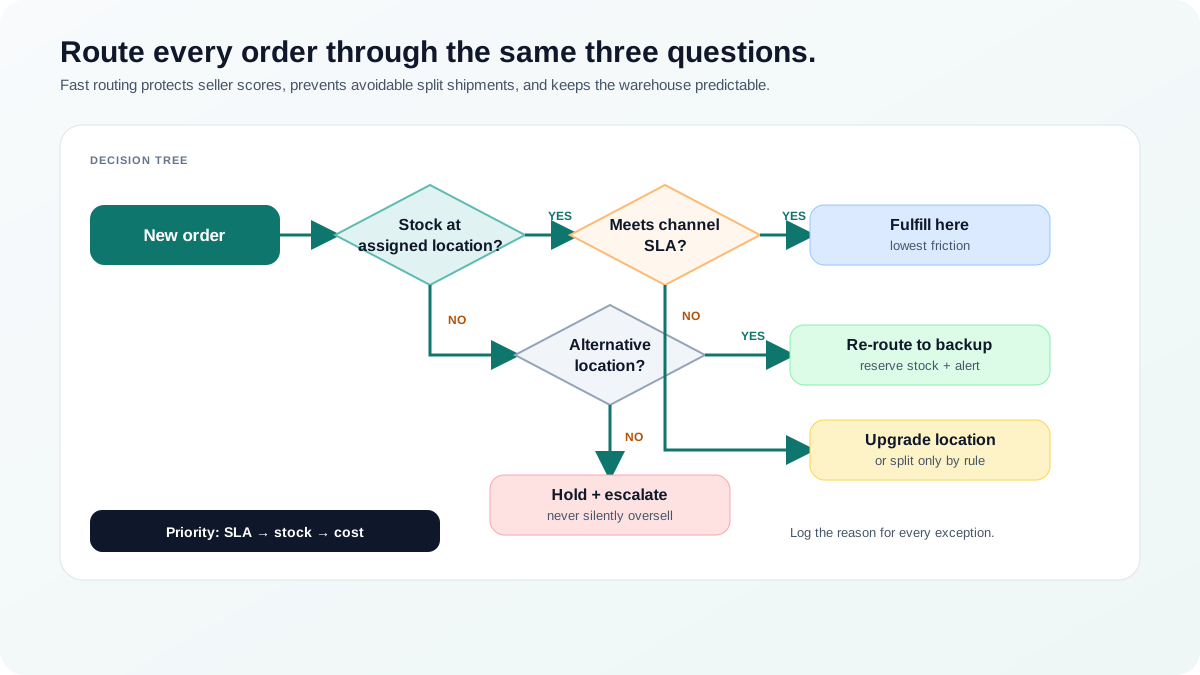
The logic for most multi-channel sellers follows this sequence:
- Is the item in stock at the assigned fulfillment location? If not, check alternative locations.
- Which fulfillment location can meet the channel's SLA? A Shopee order with a 2-day SLA can't ship from a 3PL that takes 24 hours just to process.
- Which carrier does the channel require or prefer? Shopee orders often must use Shopee Xpress or J&T. Shopify orders can use any carrier.
- Is there a batching opportunity? If 15 orders are going to the same region via the same carrier, batch them.
- Are there any channel-specific packaging requirements? Some channels require branded packaging or specific insert materials.
Carrier SLA Matrix
Know the cutoff times for every carrier you use. This table should be printed and posted in your warehouse:
| Carrier | Pickup Cutoff | SLA (Metro) | SLA (Provincial) | Channels |
|---|---|---|---|---|
| Shopee Xpress | 4 PM | Next day | 2-3 days | Shopee only |
| Lazada Logistics | 3 PM | Next day | 2-4 days | Lazada only |
| J&T Express | 5 PM | 1-2 days | 3-5 days | All channels |
| Flash Express | 4 PM | 1-2 days | 3-5 days | All channels |
| Own courier / Grab | 6 PM | Same day (metro) | N/A | Shopify, TikTok |
Missing a carrier cutoff by 10 minutes means the order ships tomorrow. For channels with tight SLAs, that 10 minutes is the difference between an on-time delivery and a penalty.
What Systems Do You Need for Multi-Channel Fulfillment?
At minimum: a central order management system, real-time inventory sync, and automated label generation. Beyond that, warehouse management and analytics separate efficient operations from chaotic ones.
The technology stack for multi-channel fulfillment has five layers:
1. Order Management System (OMS) Pulls orders from all channels into a single queue. Normalizes order data (different channels format addresses, item names, and shipping options differently). Provides the single view your warehouse team works from.
2. Inventory Management System (IMS) Maintains a single inventory count across all channels. When an order is confirmed on Shopee, the available quantity drops on Shopify, Lazada, and TikTok Shop within minutes. Read more about how inventory management works across marketplaces.
3. Warehouse Management System (WMS) Organizes warehouse operations: bin locations, pick lists, pack verification, and staging. Not all multi-channel sellers need a full WMS — it becomes essential around 500+ orders per day or 1000+ active SKUs.
4. Shipping and Label Generation Connects to carrier APIs, generates channel-compliant labels, and provides tracking numbers back to each marketplace. This must be automated — manually printing labels from each seller center is the single biggest bottleneck in small fulfillment operations.
5. Analytics and Monitoring Tracks fulfillment metrics: pick accuracy, pack time, shipping SLA compliance, and cost per order by channel. Without visibility into these numbers, you can't optimize.
How strong are your ecommerce operations? Score your ops in 2 minutes — Take the free scorecard. No signup required.
How Do You Handle Returns Across Multiple Channels?
Each channel has different return policies, timelines, and refund triggers. Your reverse logistics process needs channel-aware receiving and inspection workflows.
Returns are the part of multi-channel fulfillment that nobody plans for until it becomes a problem. Each marketplace has its own return window, reason codes, and refund process.
Return Flow by Channel
| Channel | Return Window | Who Pays Return Shipping | Refund Trigger |
|---|---|---|---|
| Shopify | Your policy (typically 30 days) | Varies by your policy | Manual approval |
| Shopee | 7-15 days (depends on category) | Usually seller | Auto-refund after return received |
| Lazada | 7 days | Usually seller | Auto-refund after return received |
| TikTok Shop | 15 days | Varies | Auto-refund after inspection |
The operational challenge: a returned item needs to be inspected, restocked (if sellable), and the inventory count updated across all channels. If a customer returns a Shopee order and you restock it, that unit should become available on Shopify, Lazada, and TikTok Shop as well.
Reverse Logistics Process
- Receive — Scan the return, identify the original order and channel
- Inspect — Check item condition against restocking criteria
- Decide — Restock, refurbish, or write off
- Restock — Return to bin location, update inventory across all channels
- Refund — Process according to channel-specific rules
- Report — Log return reason for product and listing improvement
Teams that don't have a structured return process end up with returned inventory sitting in a corner, not restocked, while they're simultaneously ordering more from suppliers.
How Do You Scale Multi-Channel Fulfillment?
Scaling means reducing per-order cost while maintaining SLA compliance. The levers are automation, batch optimization, staffing models, and strategic use of 3PLs for overflow.
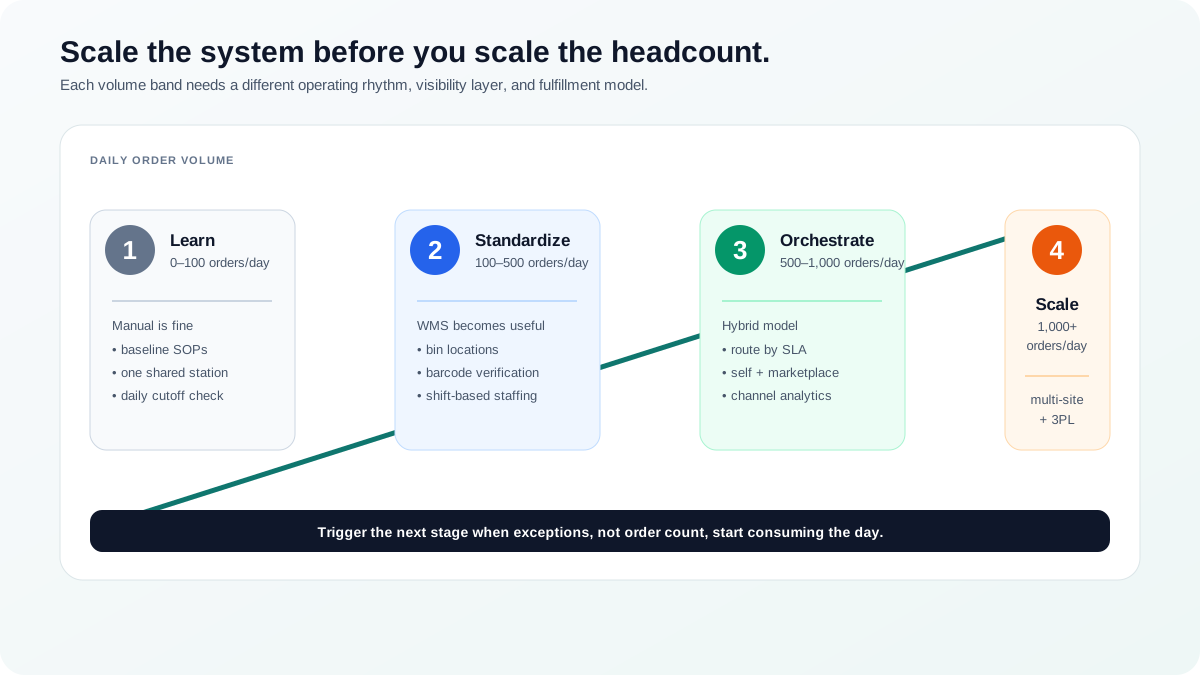
Scaling from 100 to 1000 orders per day doesn't mean hiring 10x more people. It means eliminating the manual steps that don't scale and investing in the systems that do. Deloitte's 2025 supply chain and fulfillment benchmarks show that warehouses investing in automation at the 500-order-per-day threshold reduce per-order fulfillment cost by 35% within 6 months.
Scaling Stages
Stage 1: 0-100 orders/day Manual is fine. Print labels from each seller center. Pick orders one at a time. The goal is learning which products sell on which channels and building baseline fulfillment habits.
Stage 2: 100-500 orders/day Automation becomes necessary. You need a central OMS, automated label printing, and batch picking. One person should be able to handle 100-150 orders per shift with the right tools.
Stage 3: 500-2000 orders/day WMS becomes essential. Bin locations, barcode scanning for pick verification, and shift-based staffing. Consider a hybrid fulfillment model — self-fulfill your core SKUs, use marketplace fulfillment for top sellers on each platform.
Stage 4: 2000+ orders/day Multiple fulfillment locations, sophisticated order routing, and potentially a 3PL for overflow. Analytics drive every decision — cost per order, SLA compliance by channel, and pick accuracy rates.
Key Metrics to Track
| Metric | Target | Why It Matters |
|---|---|---|
| Order-to-ship time | < 4 hours | Meets most marketplace SLAs with buffer |
| Pick accuracy | > 99.5% | Wrong items shipped = returns + penalties |
| Late shipment rate | < 2% | Marketplace scoring and visibility |
| Cost per order | Decreasing quarter over quarter | Operational efficiency indicator |
| Return rate by channel | < 5% | Product/listing quality signal |
How Do You Handle Peak Season Fulfillment?
Peak season planning starts 6-8 weeks before the event. Pre-position inventory, hire temporary staff, and establish overflow routing rules before order volume spikes.
Southeast Asian ecommerce has a dense peak season calendar: 9.9, 10.10, 11.11, 12.12, Chinese New Year, and Ramadan sales. Each one can triple your normal order volume for 3-5 days.
The brands that survive peak season without tanking their seller scores plan ahead:
6-8 weeks before: Forecast demand by channel and SKU. Place inventory orders with suppliers. Begin hiring temporary warehouse staff.
2-3 weeks before: Pre-position inventory. If you use marketplace fulfillment, send stock to their warehouses early — they impose receiving cutoffs before major sales events. Test your systems under simulated load.
1 week before: Confirm carrier capacity. Most carriers allocate pickup slots for peak season. Lock in your slots. Pre-print labels for pre-sale orders if your platform supports it.
During the event: Extend warehouse hours. Run morning and evening shifts. Prioritize orders by SLA urgency, not by arrival time. Have an overflow plan — if your warehouse hits capacity, which 3PL or fulfillment partner absorbs the excess?
After the event: Process the return wave. Peak season returns typically arrive 2-3 weeks after the sale. Have your reverse logistics process staffed and ready.
Teams that treat peak season as "a normal week but busier" end up with late shipment penalties, overselling incidents, and demoralized warehouse staff.
If you're selling on multiple marketplaces during peak events, each platform's promotional mechanics add another layer of complexity to fulfillment planning.
Frequently Asked Questions
Should I use marketplace fulfillment or fulfill orders myself?
It depends on volume and margin. Marketplace fulfillment (Shopee Fulfilled, FBL) gives you ranking benefits on that platform but locks inventory. Self-fulfillment costs less per order at scale and keeps inventory pooled. Most multi-channel sellers use a hybrid — marketplace fulfillment for their top 20% of SKUs on each platform, self-fulfillment for everything else.
How do I prevent overselling when fulfilling from multiple channels?
Real-time inventory sync is the foundation. Your inventory system needs to decrement stock across all channels within minutes of a sale, not hours. Safety stock buffers help — hold back 5-10% of inventory from marketplace listings to absorb sync delays. And during peak sales events, increase your safety buffer because sync delays get worse under load.
What's the biggest mistake in multi-channel fulfillment?
Treating each channel as an independent fulfillment operation. When you have separate processes, separate label stations, and separate inventory pools for each marketplace, you multiply your costs and complexity. Build one fulfillment system that handles all channels, with channel-specific logic only at the packing and labeling stage.
How many orders per day before I need a warehouse management system?
Around 500 orders per day or 1000+ active SKUs, whichever comes first. Below that threshold, a well-organized spreadsheet or simple OMS handles the workflow. Above it, the cost of picking errors, misplaced inventory, and inefficient warehouse travel exceeds the cost of a WMS. Some teams hit the threshold earlier if they have complex products (kits, bundles, fragile items).
Can I use a single 3PL for all my marketplace fulfillment?
Yes, if the 3PL integrates with all your sales channels and can handle channel-specific labeling requirements. Most established 3PLs in Southeast Asia support Shopee, Lazada, and Shopify. TikTok Shop integration is newer — confirm support before committing. The key question is whether the 3PL can meet the SLA requirements of your fastest channel.
Keep Reading
- What Is Ecommerce Operations? — The full picture of operational areas beyond fulfillment
- Marketplace Inventory Management — Deep dive into keeping stock accurate across channels
- Selling on Multiple Marketplaces — Strategy guide for expanding to new platforms
Find out what your operation is missing
Answer 10 questions. Get your ops score. Takes 2 minutes.
Take the Scorecard